10 Sales Lead Generation Problems AI Can Actually Solve
Every sales team wants more qualified leads, but generating them consistently has become more challenging than ever. Buyers conduct more research before speaking with sales, inboxes are flooded with outreach emails, and competition for attention continues to increase.
To compensate, many businesses simply do more. They buy larger lead lists, send more emails, hire additional sales representatives, or invest in more software. Yet despite the extra effort, the results often remain the same.
The problem usually isn’t a lack of activity.
It’s that too much time is spent on the wrong activities.
This is where artificial intelligence is beginning to make a real difference. Instead of replacing salespeople, AI helps remove repetitive work, identify better opportunities, and support smarter decision-making throughout the sales process.
In this guide, we’ll look at ten common lead generation problems that slow sales teams down and explore practical ways AI can help solve them.

Quick Takeaways
• AI works best when it improves an existing sales process rather than replacing it.
• Most lead generation problems are caused by inefficient processes, poor prioritization, or limited customer insights.
• AI helps sales teams spend more time speaking with qualified prospects instead of performing repetitive administrative work.
• Human judgment remains essential for building relationships, negotiating deals, and closing sales.
Why Businesses Are Turning to AI for Lead Generation
Ask a sales representative what takes up most of their day, and the answer usually isn’t selling.
It’s researching prospects, updating CRM records, writing emails, scheduling follow-ups, qualifying leads, and deciding who to contact next.
Individually, these tasks don’t seem like much.
Combined together, they consume hours every week.
AI helps reduce that administrative burden by analyzing customer data, recognizing patterns, automating repetitive activities, and highlighting opportunities that deserve immediate attention.
According to McKinsey & Company, generative AI has the potential to significantly improve productivity across sales and marketing by helping employees spend less time on routine work and more time engaging customers. Likewise, Salesforce’s State of Sales research shows that high-performing sales teams continue to increase their use of AI for forecasting, customer insights, and sales productivity.
The businesses seeing the greatest results aren’t replacing their sales teams with AI.
They’re giving their sales teams better tools.
Problem 1: Your Sales Team Spends More Time Researching Than Selling
Before contacting a prospect, sales representatives often research the company, identify decision-makers, review LinkedIn profiles, search for recent company news, and look for potential conversation starters.
Good preparation is important.
The problem is that repeating this process dozens of times every week leaves less time for actual selling.
How AI Helps
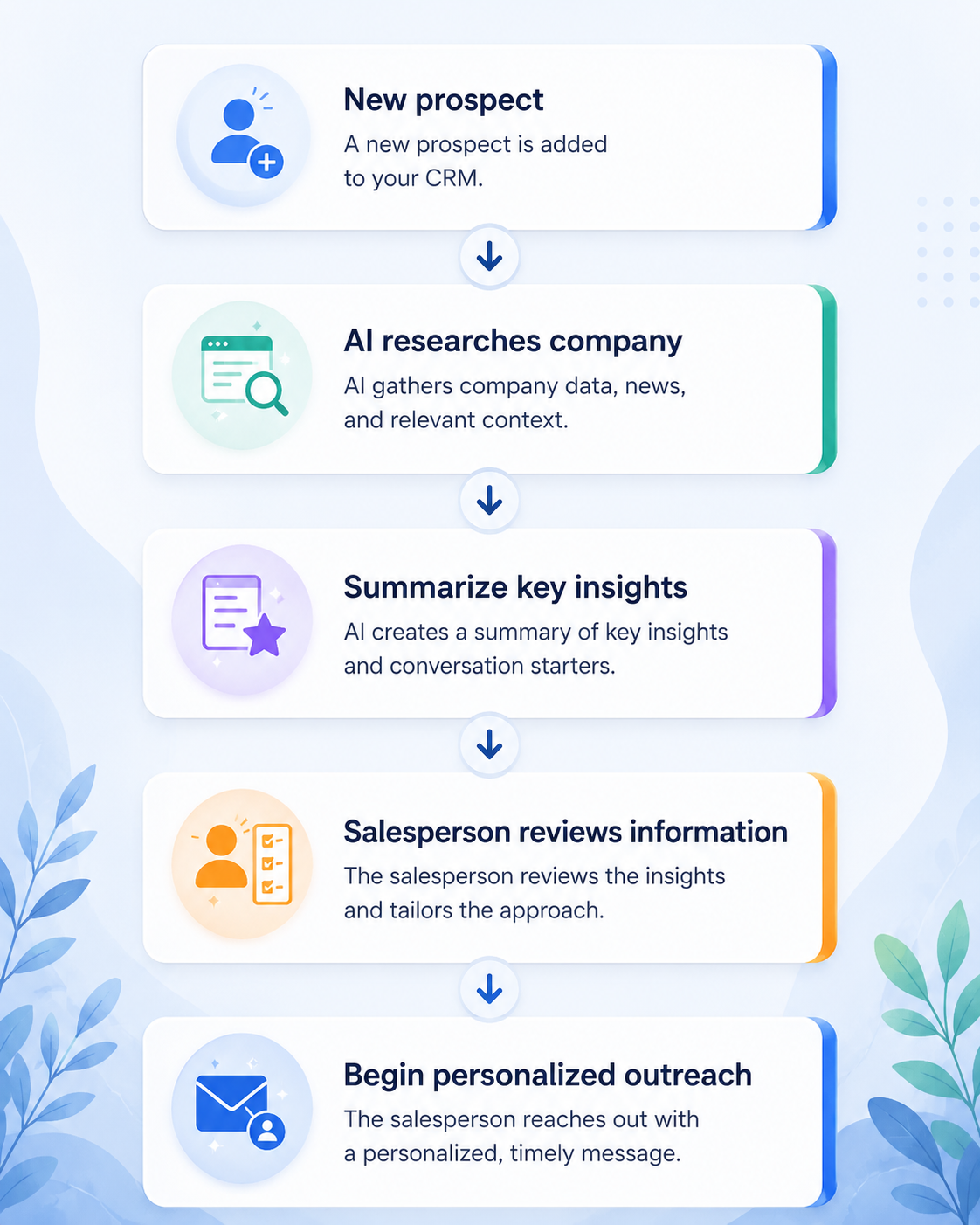
AI can gather much of this information automatically.
Instead of opening multiple browser tabs, representatives receive a summary of the company, recent developments, potential buying signals, and suggested talking points before making contact.
Preparation that once took an hour can often be completed in just a few minutes.
Example
Imagine a representative preparing for tomorrow’s meetings.
Instead of manually researching six different companies, AI provides concise summaries for each prospect before the workday even begins.
The representative spends the morning having conversations instead of collecting information.
Simple Process
Problem 2: Your Team Keeps Chasing the Wrong Leads
Not every lead deserves immediate attention.
Some are ready to buy.
Others are simply researching the market.
Without a reliable qualification process, sales representatives often spend valuable time following up with prospects that were never likely to become customers.
This not only reduces productivity but also delays conversations with people who are genuinely interested.
How AI Helps
AI analyzes customer behavior, previous interactions, CRM history, website activity, and buying intent to identify which leads are most likely to convert.
Instead of treating every inquiry the same, sales teams can focus their attention where it’s most likely to produce results.
Businesses that combine predictive AI with structured lead scoring often create a much healthier sales pipeline because opportunities are prioritized using both customer behavior and historical sales data.
Example
Two prospects complete the same contact form.
One immediately visits your pricing page, downloads a buying guide, and schedules a demo.
The other downloads a single article and never returns.
AI recognizes these differences automatically, helping salespeople prioritize the stronger opportunity.
Problem 3: Cold Outreach Feels Generic
Today’s buyers receive countless sales emails every week.
Generic messages that begin with “I wanted to introduce our company” rarely stand out.
Personalization works much better, but researching every prospect individually takes time.
How AI Helps
AI can review publicly available company information, recent business news, industry trends, and previous interactions to help sales representatives draft more relevant outreach.
The message still benefits from human editing, but representatives begin with a personalized draft instead of a blank page.
Example
Rather than sending identical emails to every manufacturing company, AI notices that one prospect recently opened a new production facility.
That insight becomes the opening line of the email, making the outreach feel far more relevant.
Companies that personalize outreach consistently often see stronger engagement because prospects feel the conversation is based on their business rather than a template.
Problem 4: Too Many Leads Slip Through the Cracks
Lead generation doesn’t stop once someone completes a contact form.
Prospects still need timely follow-ups, reminders, meeting scheduling, and consistent communication.
Without a structured process, it’s surprisingly easy for opportunities to be forgotten.
One representative follows up immediately.
Another waits until the following week.
Some leads never receive a response at all.
How AI Helps
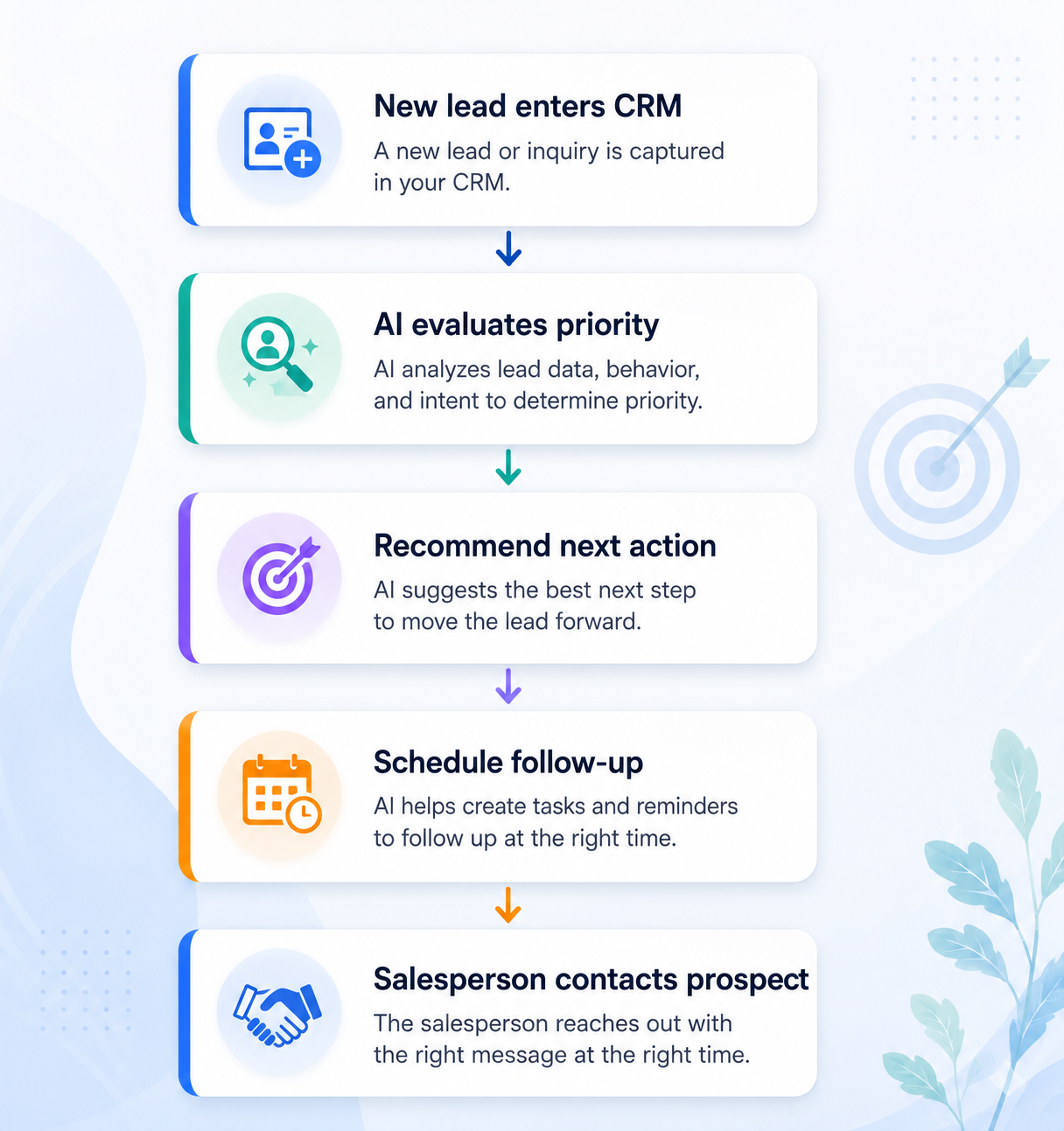
AI works particularly well when combined with CRM workflows.
Once a lead enters the CRM, AI can recommend the next action, prioritize follow-ups, remind representatives about overdue tasks, and identify opportunities that haven’t received attention recently.
Businesses with organized CRM workflows often experience more consistent customer communication because repetitive activities no longer depend entirely on memory.
How It Works
Problem 5: You Have Plenty of Data but Very Few Insights
Most businesses already collect enormous amounts of customer information.
Website analytics.
CRM records.
Email engagement.
Sales activities.
Meeting notes.
The challenge isn’t collecting data.
It’s understanding what the data actually means.
Many sales managers spend hours reviewing reports without discovering clear patterns that improve decision-making.
How AI Helps
AI connects information across multiple systems and identifies trends that would be difficult to spot manually.
For example, it may discover that prospects from a particular industry consistently close faster, or that opportunities involving multiple decision-makers generate larger deal values.
These insights help businesses improve prospecting, qualification, and forecasting without requiring hours of manual analysis.
Problem 6: Your Sales Team Spends Too Much Time Updating the CRM
Ask any salesperson what they enjoy least about their job, and updating the CRM usually ranks near the top.
After every call or meeting, they need to record notes, update deal stages, schedule follow-ups, and log customer interactions. While these tasks are important, they also reduce the amount of time available for selling.
As the number of prospects grows, administrative work grows with it.
How AI Helps
AI can automatically summarize meetings, suggest CRM updates, recommend the next best action, and even draft follow-up emails based on the conversation.
Instead of spending fifteen minutes updating records after every meeting, sales representatives can review AI-generated notes, make small edits if necessary, and move on to the next customer.
The result is a more accurate CRM without increasing administrative work.
Example
Imagine finishing five discovery calls in one afternoon.
Rather than manually typing pages of notes, AI generates summaries, identifies action items, and updates the CRM while the salesperson prepares for the next meeting.
Problem 7: Your Sales Pipeline Keeps Stalling
Almost every sales team has deals that seem to stop moving for no obvious reason.
A prospect was highly engaged one week, then suddenly stopped responding.
A proposal was sent, but weeks passed without an update.
Sales managers often discover these stalled opportunities only when reviewing forecasts at the end of the month.
By then, it may already be too late.
How AI Helps
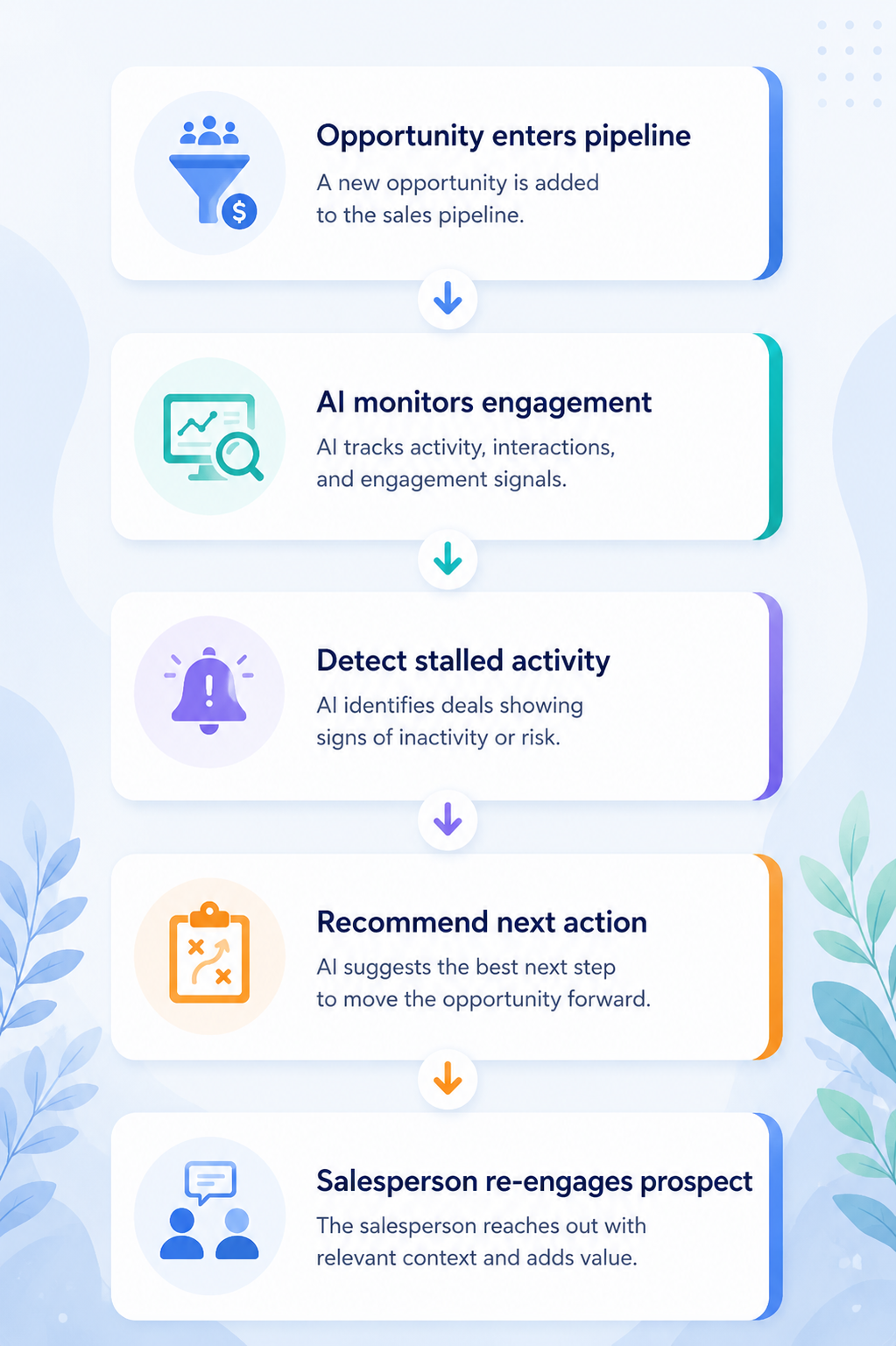
AI monitors pipeline activity continuously.
It can detect warning signs such as declining email engagement, missed meetings, longer response times, or opportunities sitting in the same stage for too long.
Instead of reacting after a deal has already gone cold, sales teams receive early warnings that allow them to re-engage the customer.
How It Works
Problem 8: You’re Missing Opportunities Inside Existing Customers
Lead generation usually focuses on finding new customers.
But some of the best opportunities are already doing business with you.
A customer might be adding new employees, expanding into new markets, or using your product more frequently. Those changes often create opportunities for upgrades or additional services.
Unfortunately, these buying signals are easy to miss when account managers oversee dozens or even hundreds of customers.
How AI Helps
AI continuously analyzes customer activity and identifies accounts showing signs of growth.
Instead of waiting for customers to ask about additional products, sales teams can start the conversation first.
Businesses that combine AI insights with strong customer relationship management often generate additional revenue without increasing their lead generation budget. This becomes even more effective when customer data is centralized inside modern CRM software.
Problem 9: Your Sales Team Can’t See What’s Actually Working
Many businesses collect plenty of sales data but struggle to turn it into useful insights.
Managers review dashboards showing email opens, meetings booked, and deals created, yet still find it difficult to answer important questions.
Which lead sources produce the highest-quality customers?
Which outreach messages generate the most replies?
Which industries close the fastest?
Without those answers, improving sales becomes largely a matter of trial and error.
How AI Helps
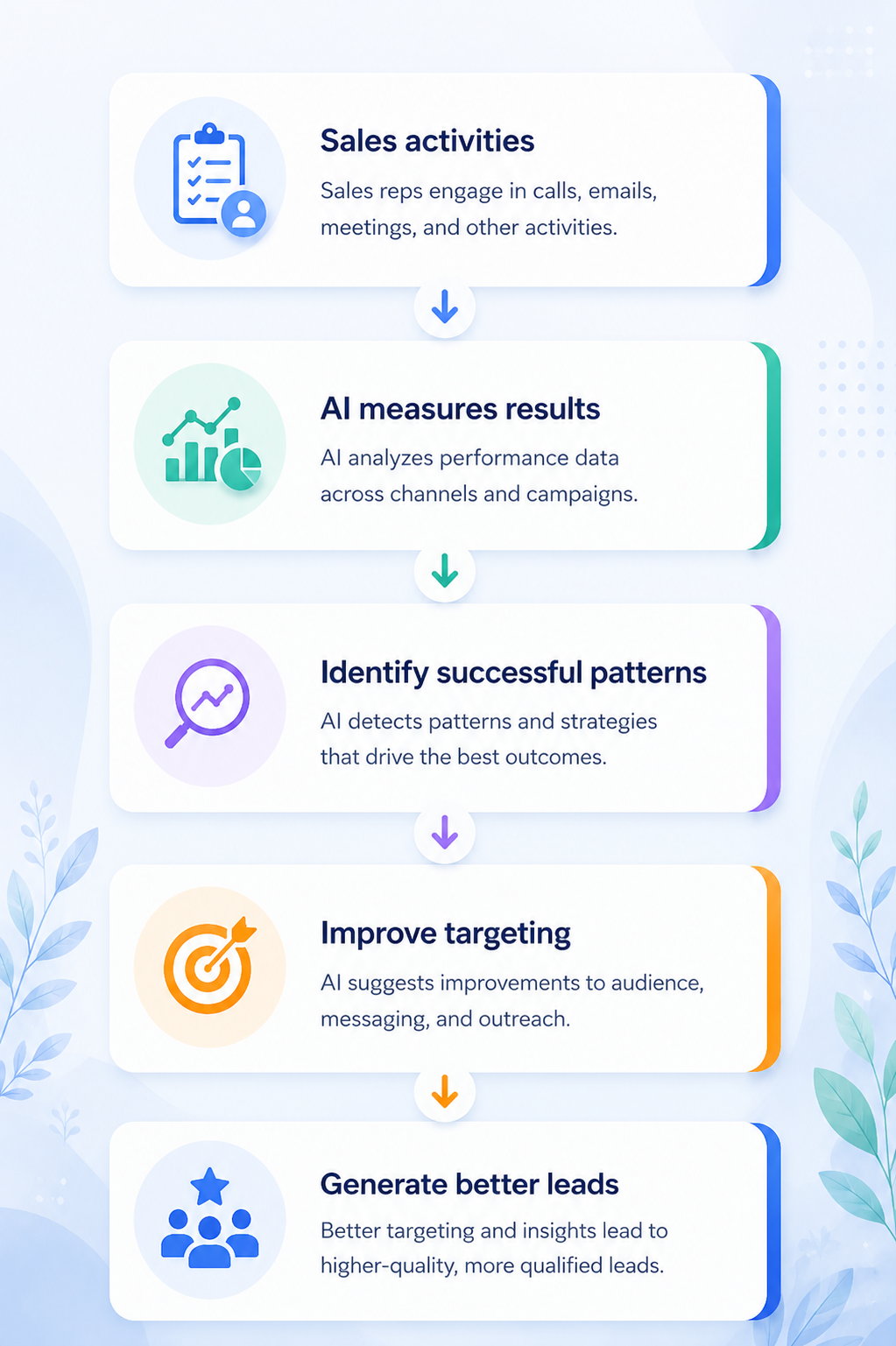
AI analyzes sales activities across the CRM and identifies patterns that would take hours to uncover manually.
Instead of simply reporting what happened, AI helps explain why it happened.
These insights allow sales managers to improve targeting, adjust messaging, and allocate resources more effectively.
Problem 10: You’re Doing More Work but Seeing the Same Results
This is perhaps the most frustrating problem of all.
The sales team sends more emails.
Makes more calls.
Books more meetings.
Yet revenue barely changes.
When this happens, the answer usually isn’t working harder.
It’s working smarter.
More activity doesn’t automatically produce better opportunities.
How AI Helps
AI helps businesses focus on quality rather than quantity.
Instead of measuring success by the number of emails sent or calls completed, AI highlights the activities most likely to generate revenue.
That shift allows sales teams to spend more time with qualified buyers and less time chasing opportunities that were unlikely to close.
Continuous Improvement
Common Mistakes Businesses Make When Using AI
Artificial intelligence can improve lead generation, but it’s not a shortcut to better sales.
One common mistake is assuming AI can replace the entire sales process. It can’t.
Customers still expect genuine conversations, thoughtful recommendations, and people who understand their business.
Another mistake is automating poor processes.
If your qualification process is inconsistent or your CRM contains outdated information, AI simply works with bad data.
Finally, avoid measuring success by activity alone.
Sending twice as many emails doesn’t matter if the quality of your leads hasn’t improved.
According to Microsoft’s guidance on responsible AI adoption, organizations achieve better results when AI is used to support human decision-making rather than replace it.
Best Practices for Using AI in Lead Generation
Businesses that achieve the greatest success with AI usually follow a few simple principles.
Start with one problem rather than trying to automate your entire sales process.
Make sure your CRM data is accurate before introducing AI.
Continue reviewing AI recommendations instead of accepting every suggestion automatically.
Most importantly, measure outcomes that actually matter, such as qualified leads, meetings booked, conversion rates, and revenue generated.
The businesses seeing the strongest results aren’t using AI because it’s trendy.
They’re using it because it helps salespeople spend more time building relationships and less time performing repetitive work.
Frequently Asked Questions
Will AI replace sales representatives?
No. AI helps automate repetitive tasks such as research, lead scoring, meeting summaries, and follow-up recommendations, but relationship building, negotiation, and closing deals still depend on people.
Which sales teams benefit the most from AI?
Almost every sales team can benefit, but organizations with a structured sales process and clean CRM data usually see the greatest improvements because AI has better information to analyze.
Is AI expensive to implement?
Not necessarily.
Many CRM platforms already include AI-powered features, while standalone AI tools are available at different price points for businesses of all sizes.
Can small businesses use AI for lead generation?
Yes.
Small businesses often benefit the most because AI helps smaller teams accomplish work that previously required additional staff.
What’s the best place to start?
Choose one repetitive task that consumes significant time, such as prospect research, lead qualification, or follow-up prioritization.
Once that process is working well, expand gradually.
Final Thoughts
Artificial intelligence isn’t replacing successful sales teams—it’s helping them become more effective.
The businesses seeing the biggest improvements aren’t the ones using the most AI. They’re the ones using AI to eliminate repetitive work, uncover better opportunities, and make smarter decisions while allowing their salespeople to focus on conversations that build trust and close deals.
As AI continues to evolve, lead generation will become less about sending more emails or making more calls and more about reaching the right people with the right message at the right time.
Technology can identify patterns, prioritize opportunities, and automate routine tasks, but it still can’t replace curiosity, empathy, or genuine human relationships. Those qualities remain the foundation of successful selling.
The companies that combine AI with a well-defined sales process, accurate CRM data, and skilled sales professionals won’t simply generate more leads—they’ll generate better leads, build stronger customer relationships, and create a lasting competitive advantage.
AI isn’t the future of sales. Smarter selling is. AI simply helps you get there faster.
