Creating contracts has never been faster or easier. In 2026, AI-powered tools are transforming how businesses draft, review, and finalize agreements. These platforms now handle everything from generating legally sound contracts in seconds to managing approvals and responding to counterparties. Here's what you need to know:
- AI Features: Tools like Genie AI and Sirion use advanced AI to analyze contracts, detect risks, and even automate actions like ERP updates.
- Speed Gains: Contracts are now created in an average of 18 minutes, cutting negotiation times by nearly 50%.
- CRM Integration: Platforms like Ironclad and Evisort integrate directly with Salesforce and other CRMs, auto-filling deal data and reducing manual errors.
- Compliance: With the EU AI Act in effect, vendors must now meet stricter standards for transparency and oversight.
Quick Comparison
| Tool | Key Feature | Best For | CRM Integration | Pricing | Drafting Environment |
|---|---|---|---|---|---|
| Genie AI | Clause library, risk detection | Sales teams | Salesforce | Free–$600/month | Web + MS Word add-in |
| Spellbook | Inline AI suggestions in Word | Word-based workflows | Microsoft Word | ~$179/user/month | Microsoft Word |
| Sirion | Breach detection, ERP actions | Enterprise procurement | ERP systems | Contact vendor | Browser-based |
| Evisort | AI-driven data extraction | Contract analysis, tracking | Salesforce | $15,000–$300,000/year | Browser-based |
| Ironclad | Workflow automation, AI approvals | Mid-market to enterprise | Salesforce, SAP | $30,000–$150,000+/year | Browser-based |
These tools save time, reduce errors, and ensure compliance, making them essential for modern contract workflows. These tools are part of a broader trend to increase sales using AI across the entire revenue cycle.
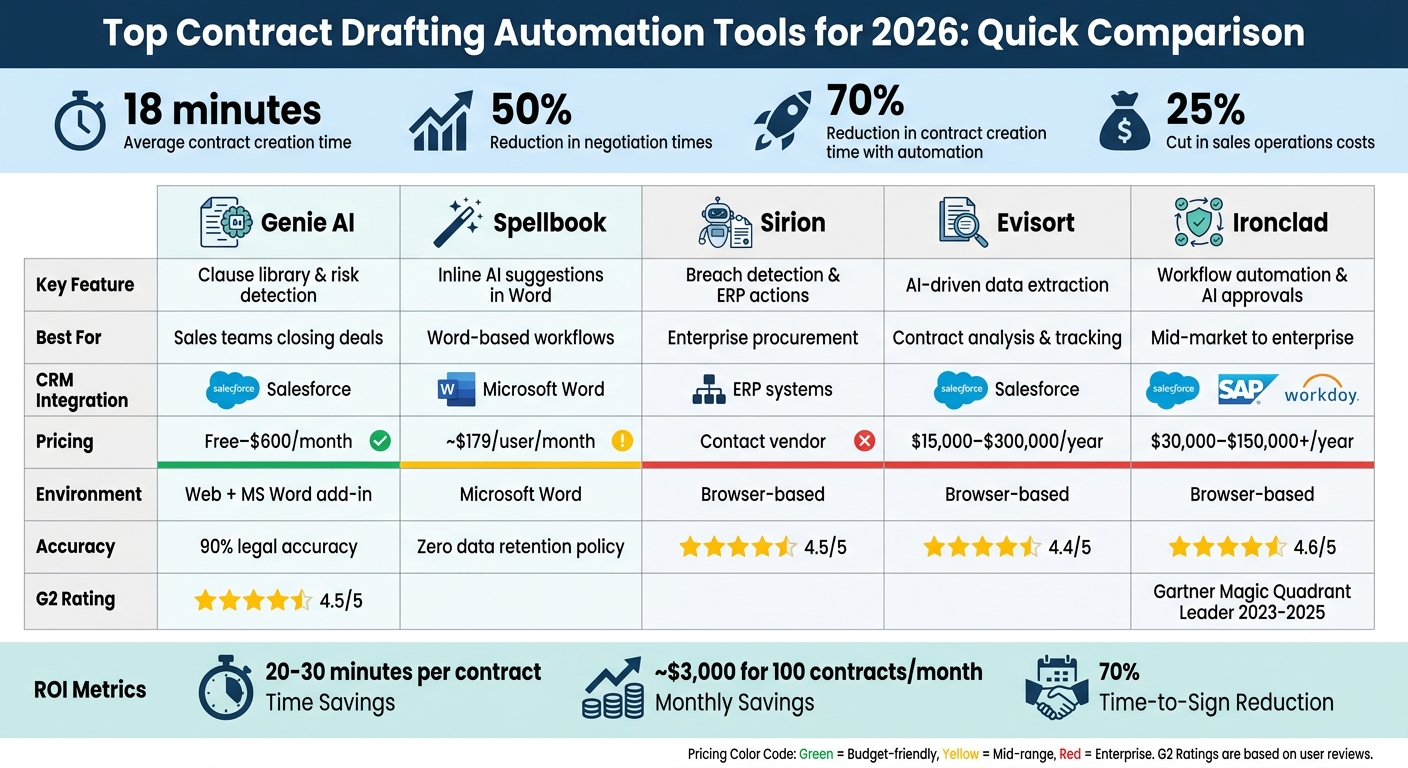
Contract Drafting Automation Tools 2026: Feature and Pricing Comparison
10 Best AI Contract Management Software
sbb-itb-8aac02d
Best Contract Drafting Automation Tools in 2026
Contract automation has evolved into two main categories: Microsoft Word add-ins and browser-based platforms. Tools like Spellbook integrate directly with Word, offering in-document AI suggestions, while platforms like Sirion, Ironclad, and Evisort operate within browsers to eliminate version control issues. Below, we’ll explore the standout features and pricing models of these tools.
Modern tools are now leveraging agentic AI to handle contract tasks autonomously. For instance, Sirion's "AskSirion" agent can analyze a contract, detect breaches, and initiate actions in connected ERP systems without requiring human input. According to Sirion's documentation:
AI is moving from chatbots to agents, and CLM is perfectly positioned for this: AI reads the contract, identifies a breach, and automatically triggers an ERP action.
The gap in accuracy between generic AI and specialized contract tools is striking. Genie AI's "Eidetic Intelligence" system, for example, achieved 90% legal accuracy in a test involving 65 documents, compared to just 37.3% for standard ChatGPT. This capability ensures new drafts align with an organization’s historical negotiation patterns. In fact, Bright Renewables reported that in 2026, their 25-person sales team negotiated contracts using Genie AI without needing a dedicated legal department.
Pricing for these tools varies based on features and company size. Genie AI offers a free tier, with Pro plans at $75/month and Enterprise plans at $600/month. Spellbook is priced at around $179 per user per month, while Ironclad starts at $25,000 annually, with typical deployments ranging from $30,000 to $250,000 or more. Juro's median annual cost is approximately $34,500.
These tools also integrate seamlessly with CRM systems like HubSpot to speed up sales workflows. For example, Ironclad and Genie AI allow sales reps to generate contracts directly from CRM opportunity records, automatically populating drafts with deal data. Companies like Dropbox and Procore use Ironclad's workflow builder to automate multi-department approval processes based on contract value and risk. Meanwhile, Slush used Bind in 2026 to draft sponsor, vendor, and speaker agreements using conversational AI. These features highlight the growing sophistication of contract tools like Genie AI, which excel in specialized contract intelligence.
Genie AI
Genie AI’s standout feature is its "Eidetic Intelligence" system, which acts as a memory bank for past contracts. This system achieved 90% legal accuracy in tests by learning from previous negotiation positions and applying that knowledge to new drafts. Genie AI offers three pricing tiers: a free plan for basic use, Pro at $75/month for growing teams, and Enterprise starting at $600/month for larger organizations. Its deep Salesforce integration allows sales teams to request contracts directly from opportunity records, streamlining the process. Available as both a web app and a Microsoft Word add-in, Genie AI is especially useful for sales teams without dedicated legal departments, helping them close deals faster.
Spellbook
Spellbook provides inline AI suggestions directly within Microsoft Word, making it a convenient tool for teams already using Word-based workflows. It offers features like clause suggestions, benchmarking data, and redlining tools, all while adhering to a zero data retention policy to protect sensitive information. Priced at approximately $179 per user per month, Spellbook helps sales teams draft contracts quickly and efficiently by delivering context-aware suggestions tailored to specific contract types.
Sirion
Sirion’s AI-native platform uses agentic architecture to handle complex contract-related tasks autonomously. Its "AskSirion" agent can read contracts, identify breaches, and trigger actions in connected ERP systems. As noted in its documentation:
AI is moving from chatbots to agents, and CLM is perfectly positioned for this: AI reads the contract, identifies a breach, and automatically triggers an ERP action.
Sirion is highly regarded in enterprise procurement, excelling in managing intricate, multi-party agreements. With a 4.5/5 rating on G2, it stands out for its advanced AI capabilities, which help sales teams speed up contract execution.
Evisort
Evisort specializes in large-scale contract management, using AI-powered tools to extract key terms and populate templates with data from integrated CRM and ERP systems. It also offers post-signature tools for tracking obligations and managing renewals. Pricing ranges from $15,000 to $300,000 annually, depending on contract volume and features. Evisort is particularly popular in industries like finance and healthcare for its strong obligation monitoring. With a 4.4/5 rating on G2, it aids sales teams by providing relevant precedents and approved language during drafting, reducing negotiation delays.
Ironclad
Ironclad offers a comprehensive contract lifecycle management (CLM) solution, combining AI drafting, risk detection, and workflow automation in one platform. Its "Jurist" AI agents handle tasks like obligation tracking, invoice reconciliation, and approval routing, enabling the system to manage complex processes independently. Recognized as a Gartner Magic Quadrant Leader from 2023 to 2025, Ironclad boasts a 4.6/5 rating on G2. It is widely used by large enterprises to streamline contract management and accelerate sales cycles.
Feature Comparison Table
The table below provides a side-by-side look at how each tool stacks up, focusing on their strengths, ideal use cases, CRM and sales integration capabilities, pricing, and drafting environments.
| Tool | Primary Strength | Best For | CRM/Sales Integration | Pricing Tier | Drafting Environment |
|---|---|---|---|---|---|
| Genie AI | Clause library & risk detection | Sales teams closing deals | Salesforce integration for contract requests | Free; Pro at $75/month; Enterprise from $600/month | Web app + MS Word add-in |
| Spellbook | Word-native AI copilot with inline suggestions | Teams using Word-based workflows | Operates within Microsoft Word | ~$179/user/month | Microsoft Word |
| Sirion | Autonomous breach detection and ERP actions | Enterprise procurement and complex agreements | Connected ERP systems | Enterprise-level pricing (contact vendor) | Browser-based platform |
| Evisort | AI-driven data extraction and semantic search | Legacy contract analysis and obligation tracking | Salesforce integration | Starting at ~$25,000/year | Browser-based platform |
| Ironclad | Workflow automation with AI-driven approval routing | Mid-market to enterprise with complex approval needs | Deep integrations with Salesforce, SAP & Workday | ~$30,000–$150,000+/year | Browser-based platform |
Key Insights
- Spellbook is a standout for teams heavily reliant on Word-based workflows, offering seamless inline suggestions within Microsoft Word.
- Genie AI and Ironclad shine when it comes to CRM integration, providing strong connections to platforms like Salesforce.
According to research from World Commerce & Contracting, automating contracts can reduce contract creation time by up to 70%.
Balancing Budget and Features
Mid-market tools like Evisort start at around $25,000 annually, making them a solid choice for businesses needing advanced contract analysis without enterprise-level pricing. On the other hand, enterprise platforms like Ironclad require a larger investment, starting at approximately $30,000 per year. As one industry expert put it, "The key is finding a solution that aligns with your unique workflows, goals and budget".
This comparison highlights how these tools streamline sales processes through contract automation, helping teams work more efficiently.
How Contract Automation Connects with Sales and CRM Workflows
Contract automation tools, paired with CRM platforms like HubSpot and Pipedrive, can dramatically speed up sales processes. By integrating these tools, manual delays are eliminated. For example, when a sales rep updates an opportunity to "Contract Sent" in their CRM, the system instantly creates a contract using live deal data. Key fields - such as company names, pricing details, addresses, and effective dates - are automatically filled into pre-approved templates.
One standout feature is bi-directional sync. Any changes made during negotiations, like adjusted pricing or revised payment terms, are automatically updated in the CRM. Additionally, many tools provide in-CRM tracking, enabling sales reps to see contract statuses (e.g., draft, sent, viewed, signed) in real-time through embedded widgets.
For companies with more complex needs, advanced tools offer features like line item mapping. This allows multi-product quotes and SKUs from the CRM to be seamlessly incorporated into contracts. Approval workflows also ensure that contracts are routed to the right legal or management teams based on criteria like deal value or region.
The impact of these integrations is significant. Studies show they can reduce time-to-sign by 70% and cut sales operations costs by 25%.
"With Juro, reps can leave a pitch and have a contract sent out within ten minutes, not two days. That's a big win considering the most dangerous part of a sales cycle is when the prospect is waiting to receive more information from you." - Jessica Zwaan, COO, Talentful
To get the most from CRM integration, it’s essential to lock down sensitive clauses - like liability and indemnity - using permissions, while still giving reps the flexibility to adjust pricing. Automated notifications triggered by CRM status changes also help maintain smooth workflows. These practices are key to the efficiency gains highlighted throughout this discussion.
For additional tools and insights to enhance your sales workflows, check out Sales, Leads & CRM.
Conclusion
Picking the right contract drafting automation tool in 2026 goes beyond simply adding AI to your workflow. It's about striking the perfect balance between the speed your sales team demands and the governance your legal team requires. With contract delays increasingly stalling revenue growth, the pressure to find the right solution has never been greater.
The key is identifying where your process slows down. Is your sales team waiting on legal to draft standard agreements? If so, a drafting assistant might be the answer. On the other hand, if the challenge lies in managing approvals or tracking renewals across numerous deals, a comprehensive CLM platform could be a better fit. Pinpoint whether the delays occur during creation or routing to make an informed choice.
Integrating seamlessly with CRMs like HubSpot, Pipedrive, or Salesforce is non-negotiable. This eliminates data entry errors and ensures real-time updates. Without a bi-directional sync, you'll face headaches like duplicate data entry, version control problems, and manual status updates that slow everything down. Start by automating high-volume, low-risk documents such as NDAs or standard service agreements, then scale up to handle more complex contracts. Once integration is in place, the focus shifts to sustainable and cost-effective improvements.
AI-powered drafting tools can deliver real results, saving 20–30 minutes per contract and cutting negotiation times by about 50%. For teams managing 100 contracts a month, this translates to roughly $3,000 in operational savings. This approach not only demonstrates ROI quickly but also ensures you're balancing speed with the necessary governance.
Finally, make sure your chosen platform can adapt to new compliance standards, such as the EU AI Act, which requires transparency in AI training data and mandates human oversight for AI-generated legal content. The right tool will not only accelerate your sales cycle but also protect your organization. For more tips on improving your sales workflows, check out Sales, Leads & CRM.
FAQs
Which tool is best for my team: a Word add-in or a browser-based CLM?
When deciding between a Word add-in and a browser-based CLM, it all comes down to how your team works. A Word add-in connects directly to Microsoft Word, making it a great fit for teams handling contracts individually or in small groups. On the other hand, a browser-based CLM provides a full range of lifecycle management features - like drafting, collaboration, automation, and AI-powered reviews - making it the better choice for managing more intricate workflows involving multiple stakeholders.
What does “bi-directional CRM sync” actually change in the sales process?
Bi-directional CRM sync means that any updates made in the CRM or the contract management system are automatically updated in both systems. This real-time syncing removes the need for manual data entry, reduces errors, and ensures that sales workflows stay smooth and current.
How do these tools meet EU AI Act rules like transparency and human oversight?
These tools align with the EU AI Act by embedding AI into workflows while providing clear instructions and playbooks for handling contract processes. They prioritize transparency and maintain human oversight by allowing reviews and approvals at crucial points. This ensures AI enhances decision-making without taking over human judgment.