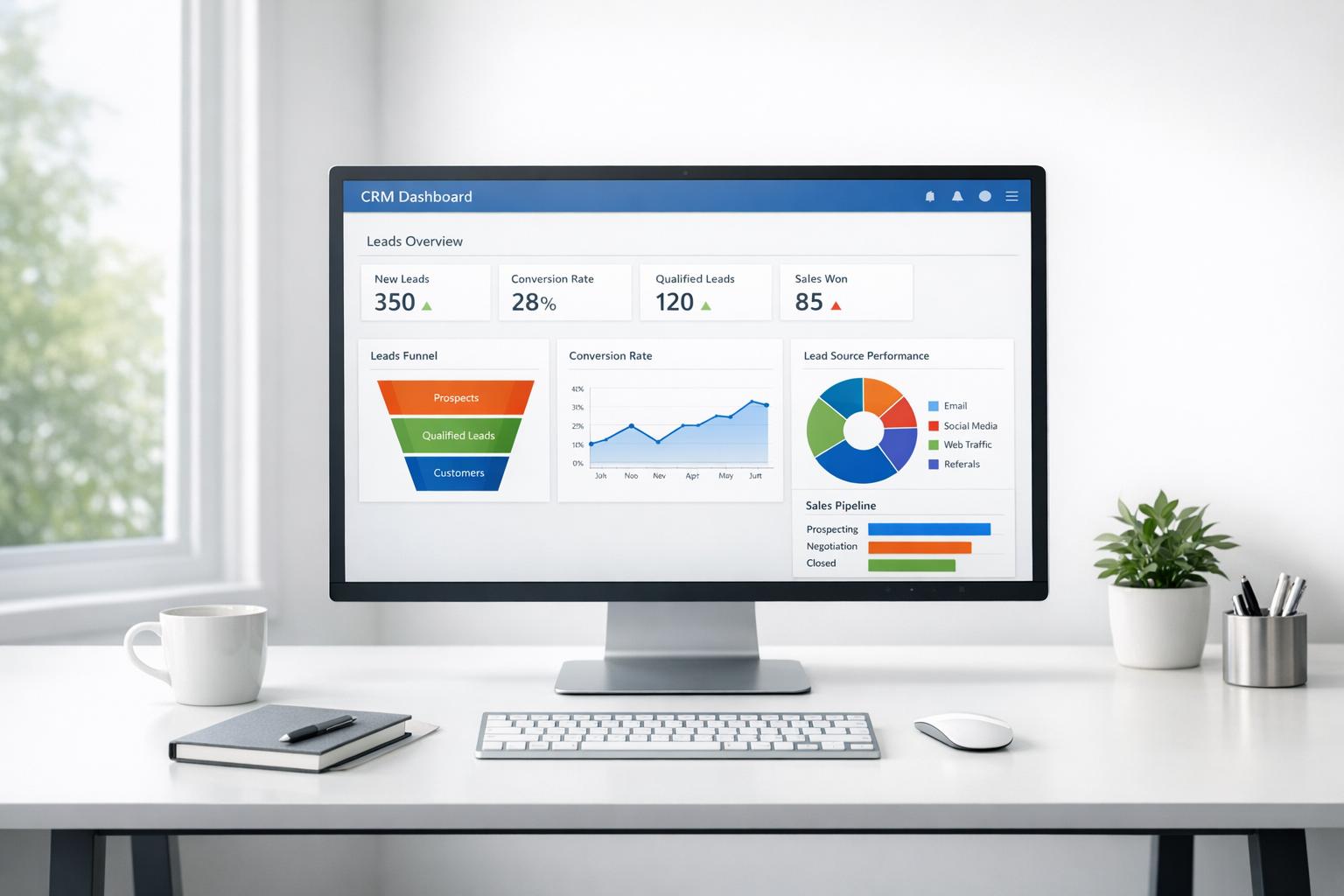
ETL tools are essential for improving sales forecasting accuracy by automating the process of extracting, transforming, and loading data to streamline sales processes from various sources into a centralized warehouse for analysis. Here are the 7 best ETL tools for sales forecasting, each with unique strengths:
- Fivetran: Offers over 700 pre-built connectors and Change Data Capture (CDC) for near real-time data syncing, ideal for large-scale operations.
- Matillion: Cloud-native with a low-code interface, leveraging your data warehouse's processing power for fast transformations.
- Integrate.io: Fixed-cost model with unlimited pipelines, great for mid-sized businesses needing predictable pricing.
- Pentaho Data Integration (PDI): Budget-friendly, open-source solution with strong CRM connectivity and hybrid deployment options.
- Alteryx: Combines no-code data prep and advanced analytics, perfect for teams building detailed sales models.
- SAP Analytics Cloud (SAC): Tailored for SAP users, integrates planning, analytics, and forecasting in one platform.
- TIBCO Spotfire: AI-driven insights with visual analytics, ideal for teams prioritizing data exploration and real-time recommendations.
Each tool has distinct pricing models and integration capabilities, so choosing the right one depends on your team's size, technical skills, and budget.
Quick Comparison:
| Tool | Pricing Model | Best For | Key Strengths |
|---|---|---|---|
| Fivetran | Usage-based (MAR) | Large enterprises | 700+ connectors, CDC, automated schema handling |
| Matillion | Credit-based | Cloud-native teams | Pushdown ELT, low-code interface |
| Integrate.io | Fixed-fee subscription | Mid-sized businesses | Unlimited pipelines, predictable costs |
| Pentaho (PDI) | Free/Quote-based | Budget-conscious teams | Open-source, hybrid deployment |
| Alteryx | Quote-based | Analysts | No-code prep, advanced forecasting tools |
| SAP Analytics | Quote-based | SAP users | Native SAP integration, unified analytics |
| TIBCO Spotfire | Tiered subscription | Data exploration teams | AI insights, visual analytics |
For the best results, test these tools with your historical sales data to ensure they meet your forecasting needs.
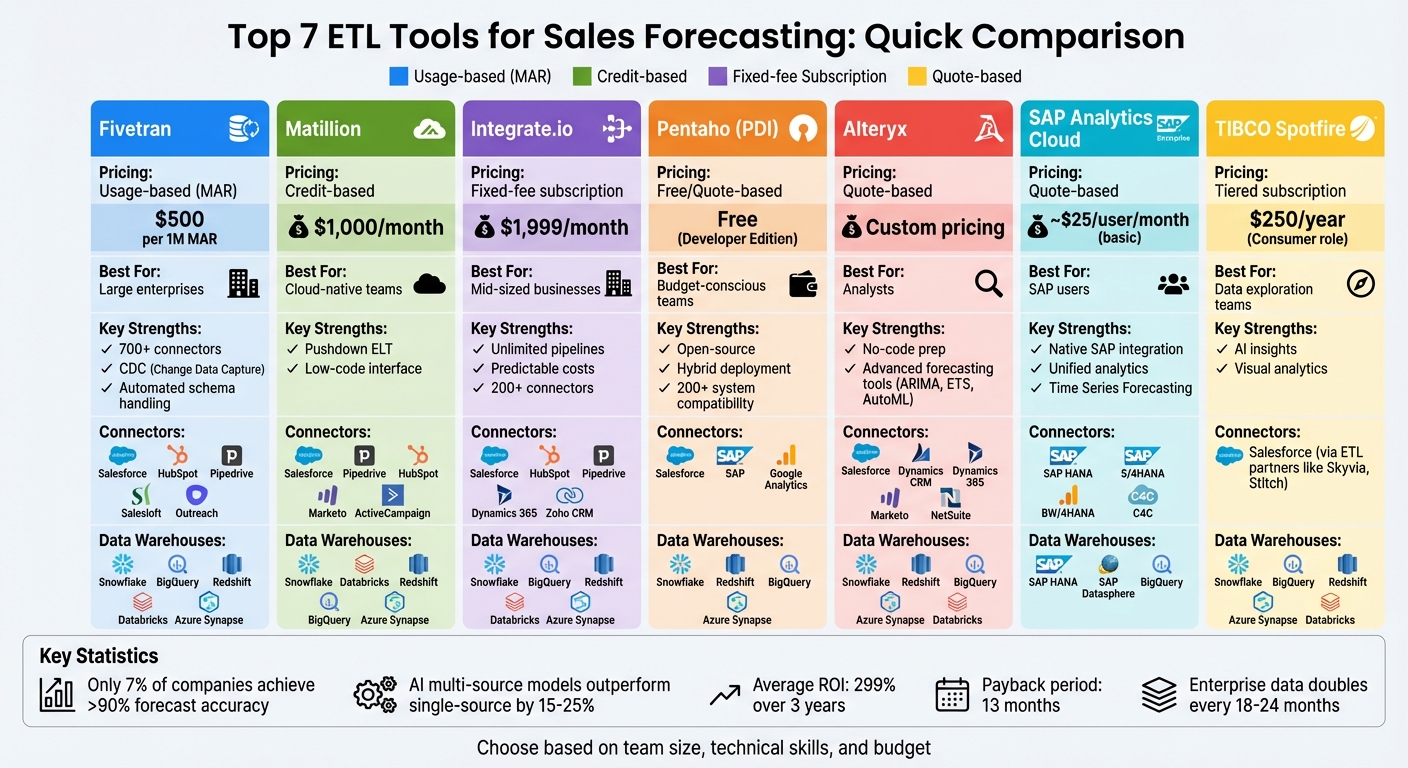
ETL Tools for Sales Forecasting: Feature and Pricing Comparison
5 of the best ETL tools, broken down by category
sbb-itb-8aac02d
1. Fivetran
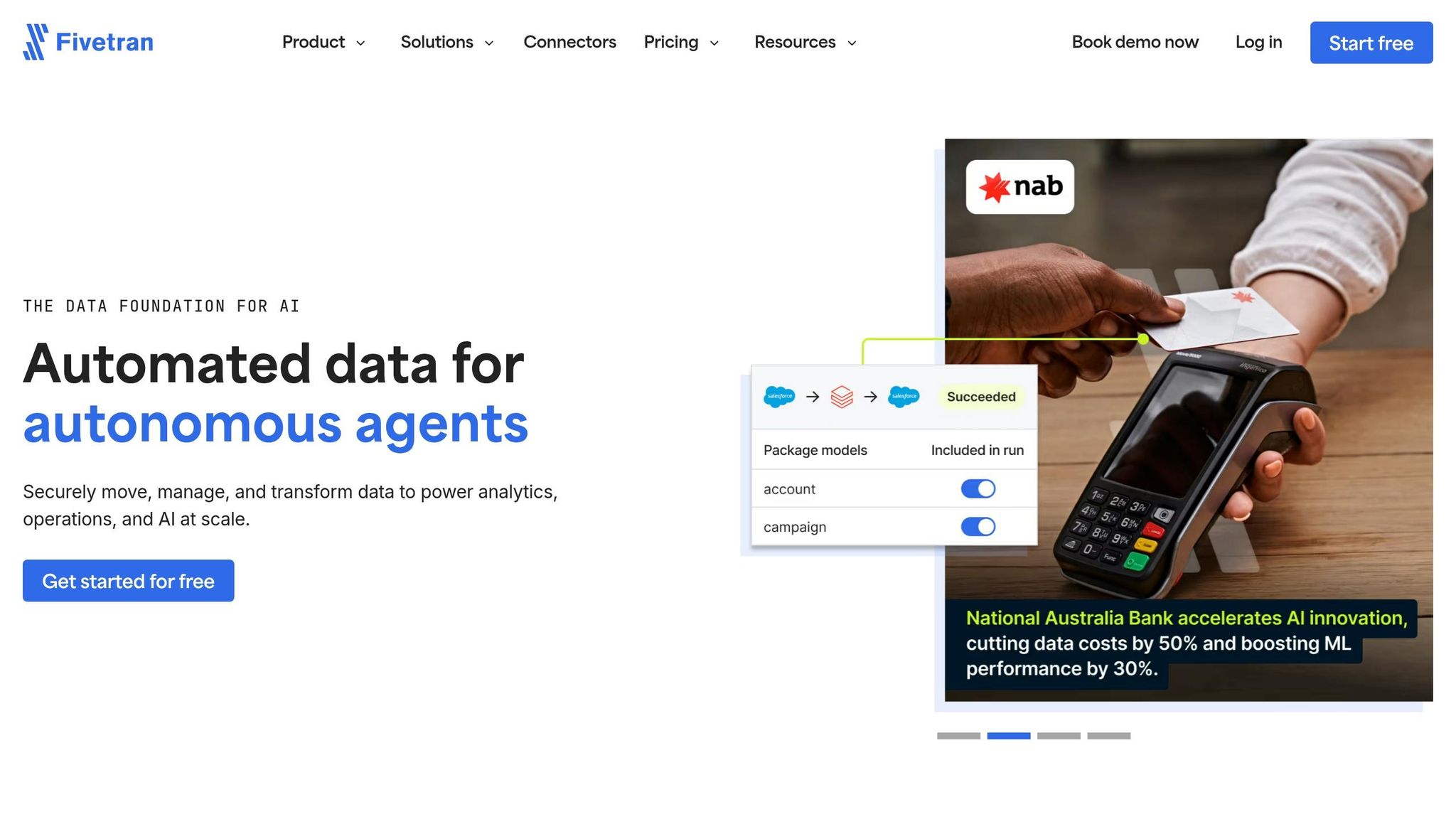
Fivetran is a managed ELT platform designed to automate the transfer of sales data from CRM systems into cloud data warehouses. With over 700 pre-built connectors, it supports major CRMs like Salesforce, HubSpot, and Pipedrive, as well as sales engagement tools like Salesloft and Outreach. The platform ensures reliable data pipelines by automatically adapting to schema changes, so your data stays consistent and up-to-date.
Connectors for CRM and Sales Data
Fivetran seamlessly moves detailed CRM data - such as deals, opportunities, accounts, leads, and activity logs - straight into your data warehouse. Using Change Data Capture (CDC), it keeps data current with an average sync latency of just 1 to 5 minutes. For those needing historical insights, the "History Mode" feature tracks changes in deal stages and values over time, which is especially useful for building forecasting models based on trends.
Take National Australia Bank, for example. They used Fivetran to cut data costs by 50% while improving machine learning performance by 30%. Similarly, Coke One North America leveraged Fivetran to provide real-time SAP data access for 35,000 users, enabling AI and ML projects across the company.
This level of connectivity ensures a solid foundation for advanced data transformation and predictive analytics.
Pricing and Cost Structure
Fivetran uses a usage-based pricing system, calculated by Monthly Active Rows (MAR) - the distinct rows added, updated, or deleted each month. For smaller teams, the Free Plan covers up to 500,000 MAR, making it a great starting point. As your data needs grow, the cost per MAR decreases automatically. For those opting for annual contracts, discounts of up to 22% are available.
Ease of Integration with Data Warehouses
Fivetran integrates effortlessly with major cloud data warehouses like Snowflake, Google BigQuery, Amazon Redshift, Databricks, and Azure Synapse. The platform handles massive volumes, managing 33.5 million schema changes and syncing over 2 trillion rows every month. A 14-day free trial is offered for each new connector, allowing you to test its sync speed and schema adaptability before committing. Once the data is in your warehouse, Fivetran works with dbt to transform raw CRM data into analytics-ready tables, perfect for forecasting and analysis.
2. Matillion
Matillion is another cloud-native ELT platform designed to streamline sales forecasting, following in the footsteps of Fivetran. It utilizes the processing power of your cloud data warehouse to transform data directly within the platform. With more than 150 pre-built connectors, Matillion integrates seamlessly with top CRM tools like Salesforce, Pipedrive, HubSpot, Marketo, and ActiveCampaign. This makes it an excellent option for sales teams aiming to build precise forecasting models.
Connectors for CRM and Sales Data
Matillion’s integrations allow users to pull in essential sales data such as deal stages, opportunity values, lead conversion rates, and activity logs directly into their data warehouse. For added flexibility, the platform includes a no-code connector builder, which makes creating custom connectors quick and straightforward. If your team needs to push insights back into CRM systems, Matillion supports Reverse ETL, enabling transformed data to sync back into platforms like Salesforce. This smooth data exchange sets the foundation for Matillion’s advanced transformation capabilities.
Sales Forecasting Capabilities
Matillion’s pushdown ELT architecture processes data transformations directly within your cloud warehouse, cutting down on job runtimes significantly. For instance, in 2025, Rob Parker, Docusign's Senior Director of Business Intelligence, shared that Matillion reduced their lengthy data jobs from over 22 hours to just 6 hours. His team mastered the platform in just 14 days and launched their infrastructure in a mere 2 days.
"I genuinely believe T is in the ETL process is where Matillion scores. The Transformation part. Getting data to a point is cool, but then transforming it and then having business impact, that's the star."
- Hoshang Chenoy, Principal Marketing Intelligence Scientist, Cisco Meraki
The platform also features Maia, an AI-powered data engineer that automates repetitive pipeline tasks, helping teams speed up the creation of sales forecasting models. For those interested, Matillion offers a 14-day free trial.
Pricing and Cost Structure
Matillion uses a consumption-based pricing model with Matillion Credits, which adapt to pipeline execution times and workload demands. The platform provides three pricing tiers:
- Developer Plan: Designed for individuals or small teams.
- Teams Plan: Adds developer users, audit logs, and an SLA for growing teams.
- Scale Plan: Built for larger organizations, offering advanced security features, hybrid cloud deployment, and extended log retention.
Users only pay for the resources they consume, and purchases can be made directly or through cloud marketplaces like AWS, Azure, or Snowflake.
Ease of Integration with Data Warehouses
Matillion is built to integrate with major cloud platforms, including Snowflake, Databricks, Amazon Redshift, Google BigQuery, and Azure Synapse. Its low-code, visual interface allows sales analysts to design data pipelines quickly, while advanced users can leverage custom SQL, Python, or dbt for more complex transformations.
For example, Western Union utilized Matillion to establish a single source of truth for customer insights, ensuring high-quality data flowed seamlessly into Snowflake under the guidance of Senior Director Pavan Yerra. Matillion’s impact has also earned it recognition, such as the Gartner Peer Insights Customers' Choice 2025 award for data integration tools.
3. Integrate.io
Integrate.io offers a standout solution for sales forecasting by combining a strong focus on CRM connectivity with a fixed-cost pricing model. This low-code ETL platform provides over 200 pre-built connectors, simplifying the process of managing and analyzing sales data. Pricing starts at $1,999 per month, covering unlimited data volumes and connectors, making it easier for businesses to plan their budgets without surprises.
Connectors for CRM and Sales Data
Integrate.io integrates smoothly with leading CRM platforms like Salesforce, HubSpot, Pipedrive, Microsoft Dynamics 365, and Zoho CRM. It retrieves both standard and custom objects while maintaining entity relationships, ensuring accurate sales forecasts. The platform's Change Data Capture (CDC) feature allows for 60-second sync cycles, offering near-real-time visibility into sales pipelines. Companies using Integrate.io for Salesforce integration often report a 40% improvement in reporting speed. Additionally, its bi-directional sync feature enables enriched data to flow back into CRM systems, further enhancing data quality and usability. These capabilities make Integrate.io a powerful tool for improving sales forecasting accuracy.
Sales Forecasting Capabilities
The platform automates key sales metrics like Annual Recurring Revenue (ARR), pipeline velocity, and deal trends. With over 220 data transformations, pre-load deduplication, and validation processes, Integrate.io ensures clean and reliable data. Its incremental loading configurations can significantly reduce API consumption - by as much as 90% compared to full data extracts.
"Integrate.io is a tool with state-of-the-art connections and is flexible, scalable and easy to work with." - Bill Heffelfinger, Head of Client Technology Solutions, CloudFactory
Seamless Integration with Data Warehouses
Integrate.io connects effortlessly with major data warehouses, including Snowflake, Google BigQuery, Amazon Redshift, Databricks, and Azure Synapse Analytics. Its drag-and-drop interface and auto-schema detection simplify the process of adapting to CRM field changes, reducing the risk of pipeline disruptions. Every subscription comes with premium support, including a dedicated Solution Engineer to assist with setup and optimization. The platform is SOC 2 Type II certified and supports GDPR, CCPA, and HIPAA-compliant usage. Recognized as a Leader by G2 in Fall 2026, Integrate.io also offers a 14-day free trial, allowing teams to explore its features before committing.
4. Pentaho Data Integration
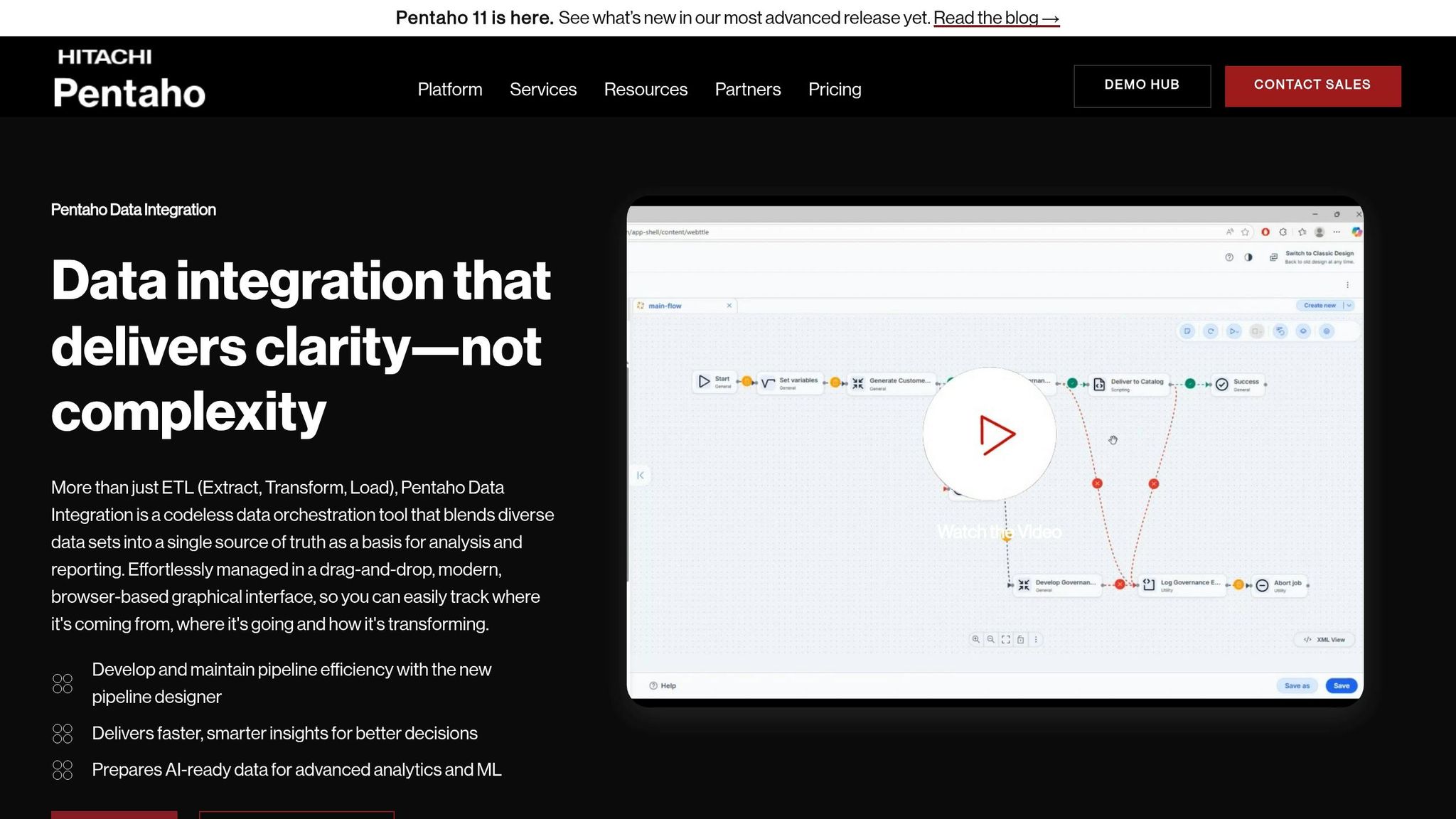
Pentaho Data Integration (PDI) is a budget-friendly enterprise ETL solution tailored for sales forecasting. With an annual cost of $15,000 to $20,000 for its Enterprise Edition and compatibility with over 200 systems via metadata injection, it’s a great match for organizations that rely on open-source technologies. Its affordability and adaptability make it particularly appealing for businesses seeking strong CRM connectivity.
Connectors for CRM and Sales Data
PDI comes equipped with enterprise-grade plugins for popular CRMs like Salesforce and SAP. It also integrates marketing tools for sales reps such as Google Analytics using metadata injection, which allows teams to create reusable transformation templates that speed up the onboarding process. This efficiency is crucial when implementing sales lead generation solutions that require clean, integrated data to accelerate the pipeline. For forecasting workflows, PDI consolidates data from multiple sources into a single, unified dataset, preparing "AI-ready" data for advanced analytics. Additionally, teams can execute machine learning models in languages like Spark, R, Python, Scala, and Weka directly within their data pipelines.
Pricing and Cost Structure
Pentaho offers four licensing tiers to meet different organizational needs: Starter (basic features), Standard (includes unlimited support and containerization), Premium (adds 24/7 support and AI-ready tools), and Enterprise (comprehensive integration capabilities). A 30-day free trial is available across all tiers, along with flexible, usage-based pricing. Companies using Pentaho report significant benefits, including an 80% reduction in data operations costs and a 55% time savings for data scientists who no longer need to spend hours locating and preparing data. For instance, VNG Handel & Vertrieb, an energy service provider, achieved a 91% reduction in storage costs with Pentaho.
"With Pentaho, we have greatly improved EULEN's time-to-insight, with users now able to access the data they need to track key business metrics near-instantly." - Juan Carlos Garcia, Leader of the Business Intelligence Team, EULEN
Ease of Integration with Data Warehouses
PDI's drag-and-drop interface simplifies the process of building data pipelines, even for users without coding experience. For Snowflake users, the platform’s Data Optimizer automates warehouse management, helping organizations save 20–40% on storage costs by moving cold data to S3 or Azure Data Lake while retaining full data lineage and visibility. PDI also integrates seamlessly with AWS Redshift, Google BigQuery, and Azure Synapse Analytics, supporting deployment across on-premises, cloud, and hybrid environments. Users have reported a 7x faster display of knowledge graphs.
5. Alteryx
Alteryx is a platform designed to simplify analytics by combining data preparation, blending, and forecasting into one solution. Its visual workflow tool, Alteryx Designer, removes the need for complex ETL scripts, making it a great choice for sales operations teams - even those without advanced coding skills. With its no-code and low-code options, users can build detailed sales forecasting models using a drag-and-drop interface. For those with more technical expertise, it also supports Python, R, and SQL, offering flexibility for a wide range of users. This balance of simplicity and power makes Alteryx a standout tool for turning raw sales data into actionable forecasts.
Connectors for CRM and Sales Data
Alteryx comes with built-in connectors for popular CRM platforms like Salesforce (featuring Input, Output, and Wave Output tools), Microsoft Dynamics CRM, and Microsoft Dynamics 365 Sales. It also supports marketing and lead data integration through tools for Marketo (with Append, Input, and Output features), Adobe Analytics, and Google Analytics 4. For enterprise sales teams, the platform integrates with tools like NetSuite, Anaplan, and ServiceNow. Given Salesforce's dominance as a CRM platform, these integrations are essential for building effective sales forecasting workflows.
Sales Forecasting Capabilities
Alteryx offers a comprehensive Time Series toolset, including ARIMA, ETS, TS Forecast, TS Covariate Forecast, and TS Model Factory. With features like Assisted Modeling and AutoML available in the Alteryx Intelligence Suite, sales teams can quickly identify the best regression or time-series models without needing deep expertise in data science. This simplifies the forecasting process and helps improve the accuracy of sales predictions.
Seamless Integration with Data Warehouses
Alteryx integrates directly with major cloud data warehouses like Snowflake, Amazon Redshift, Google BigQuery, Azure Synapse Analytics, and Databricks. Its In-Database processing capability allows users to blend and analyze large sales datasets without needing to move the data. By performing transformations directly within the warehouse, Alteryx takes advantage of modern cloud computing, speeding up data processing and avoiding the delays associated with traditional ETL workflows. This streamlined integration strengthens Alteryx's role as a key player in sales forecasting ecosystems.
6. SAP Analytics Cloud
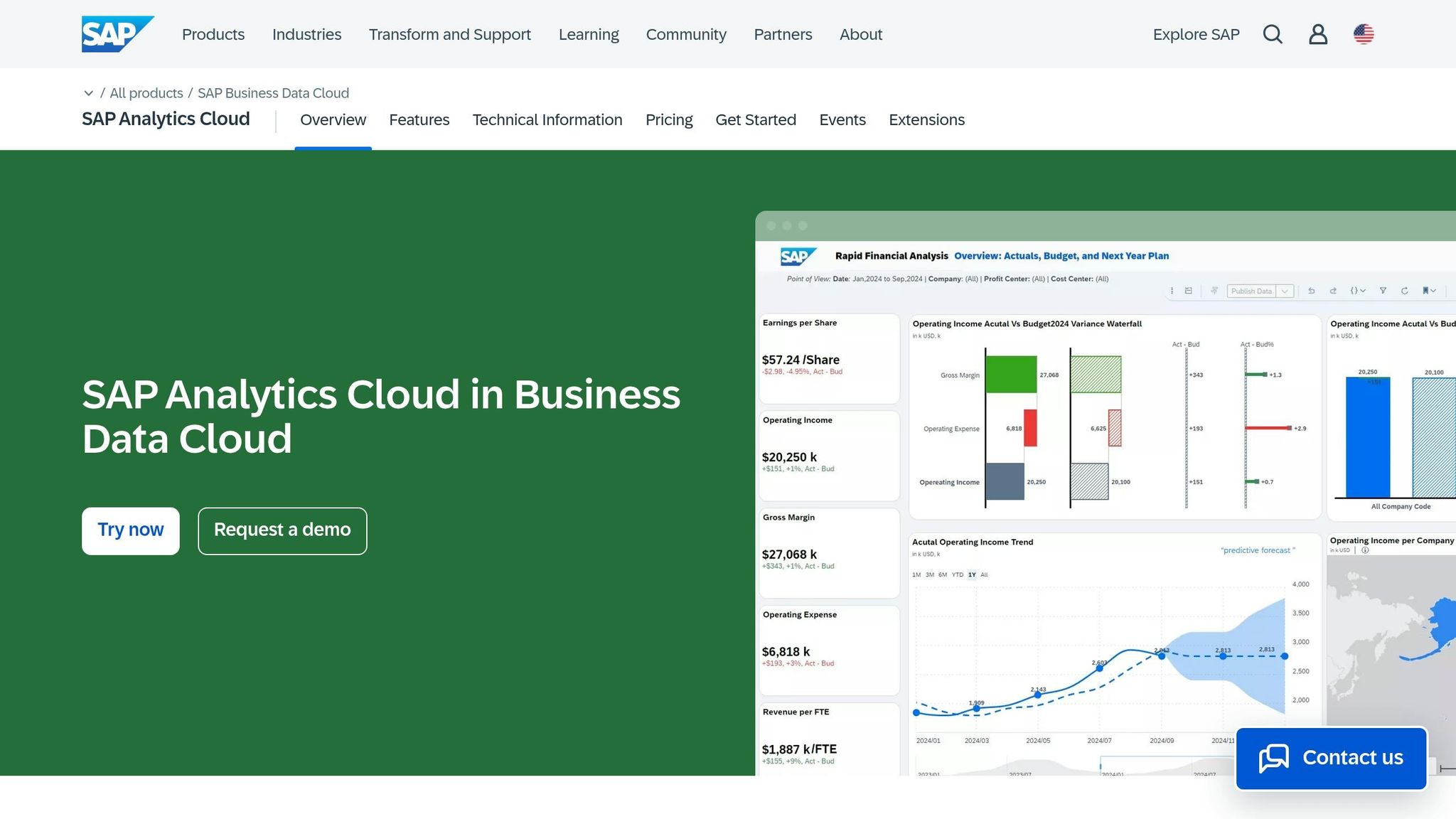
SAP Analytics Cloud (SAC) is a comprehensive platform that combines business intelligence, planning, and predictive analytics into a single cloud-based solution. It streamlines the entire analytics process - from connecting data to making forecasts and creating actionable plans. This seamless integration allows sales teams to move effortlessly from analyzing past performance to generating predictions and building sales pipeline management strategies. SAC was named a Leader in the IDC MarketScape Worldwide Business Intelligence and Analytics Platforms 2025 Vendor Assessment, showcasing its strong capabilities in data-driven forecasting.
Sales Forecasting Capabilities
SAC’s unified platform includes powerful tools for sales forecasting. One standout feature is its Time Series Forecasting, which uses historical data - like four years of regional and product sales figures - to predict future trends. The Influencer Analysis tool identifies key factors that impact forecast accuracy, helping to reduce Mean Absolute Percentage Error (MAPE). Sales teams can save these forecasts as private planning model versions, making it easier to establish baselines for inventory and stock planning.
With the Joule generative AI copilot, SAC automates reporting and reveals hidden insights, while its machine learning continuously analyzes the relationship between seller behavior and opportunity win rates. By default, the platform supports up to 1,000 entities in time series forecasts, with options to extend this capacity through specific configurations.
Connectors for CRM and Sales Data
SAC integrates natively with SAP’s ecosystem, including SAP HANA, S/4HANA, BW/4HANA, and SAP Cloud for Customer (C4C), using OData analytical queries. This direct connection lets sales teams working with SAP CRM systems import real-time sales data into their forecasting models. For non-SAP data sources, SAC supports SQL, OData, and Google BigQuery.
The platform also offers more than 100 prebuilt content packages, such as the "SAP CRM – Sales Performance" package, which simplifies the creation of sales dashboards. Additionally, SAC stories can be embedded directly into CRM interfaces using mashup technology, providing analytics in the context of users' workflows.
Ease of Integration with Data Warehouses
SAC enables live data connections to both on-premises and cloud-based data warehouses, removing the need for data replication during analysis. This feature is particularly useful for organizations using systems like SAP HANA, SAP Datasphere, BW/4HANA, or Google BigQuery. As part of the SAP Business Technology Platform, SAC integrates deeply with other SAP solutions.
To ensure a smooth user experience, SAML Single Sign-On (SSO) maps user permissions and attributes consistently between SAC and connected CRM systems.
Pricing and Cost Structure
SAP Analytics Cloud uses a SaaS subscription model with tiered, per-user pricing. The basic tier starts at around $25 per user per month, while enterprise-level tiers with advanced features can cost several hundred dollars per user per month. SAC can be purchased as a standalone solution or as part of the SAP Business Data Cloud, which bundles it with SAP Datasphere and SAP Business Warehouse. Free trials and product demos are available for those interested in exploring the platform.
7. TIBCO Spotfire
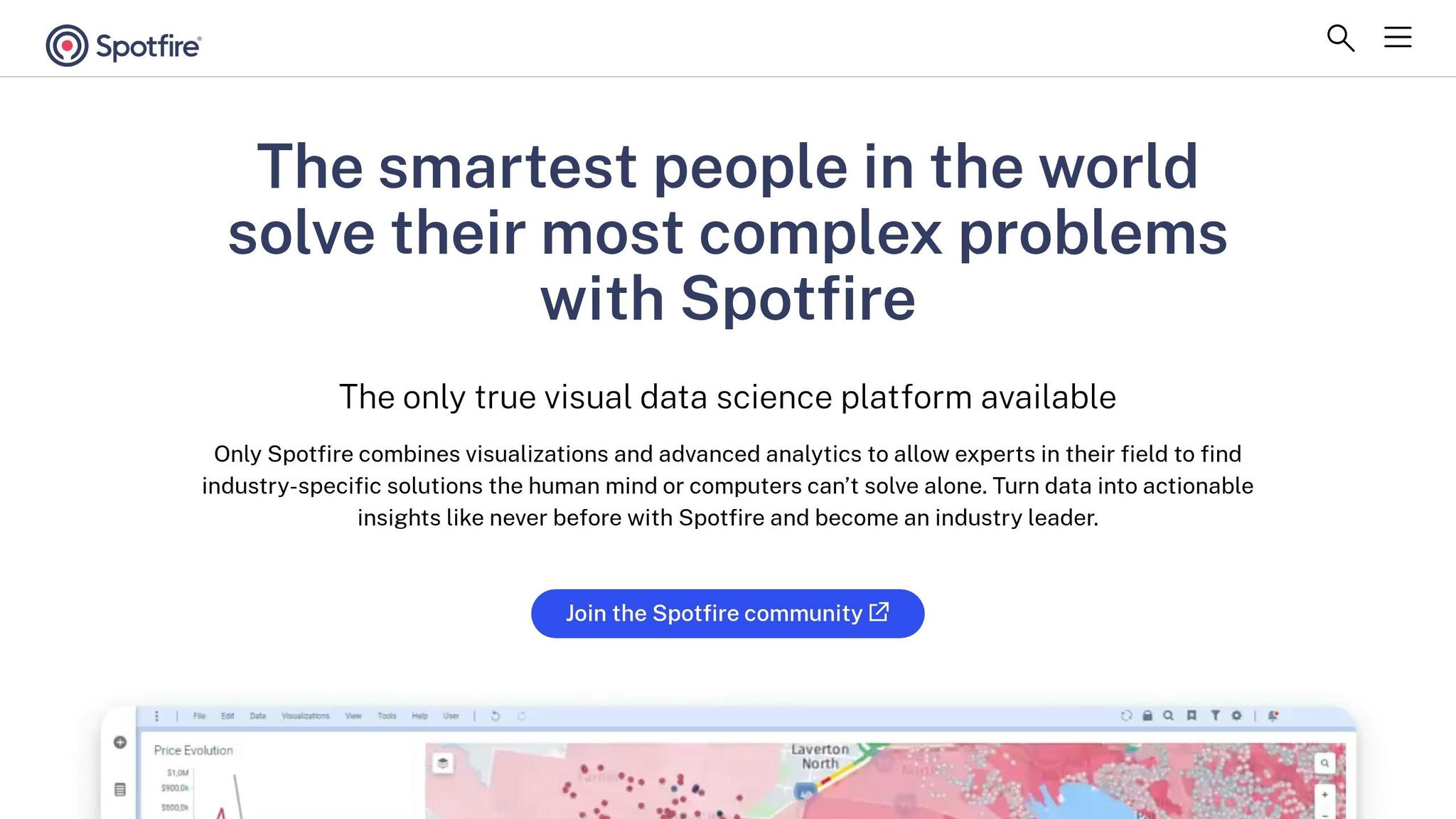
Wrapping up the list, TIBCO Spotfire combines data discovery with advanced integration tools to simplify sales forecasting. By merging AI-driven insights with intuitive data exploration, it empowers sales teams to make better-informed decisions. Its inline data wrangling feature allows users to enrich CRM data directly within the platform, eliminating data silos.
Sales Forecasting Capabilities
Spotfire leverages AI to identify trends, uncover hidden patterns, and deliver real-time recommendations, all aimed at improving forecast accuracy. The platform integrates visual, geographical, and streaming analytics to provide a detailed view of the sales pipeline. With machine learning working alongside its visual analytics, Spotfire offers actionable suggestions to boost sales performance.
In addition to its forecasting strengths, Spotfire simplifies the process of connecting to data sources and integrating with data warehouses.
Connectors for CRM and Sales Data
Spotfire supports integration with leading CRM systems through trusted ETL partners like Skyvia and Stitch. For Salesforce users, the platform can analyze a variety of data objects, including Contacts, Leads, Opportunities, Accounts, and even custom objects. This helps consolidate sales data into a unified analytics environment.
Ease of Integration with Data Warehouses
The platform connects effortlessly to modern cloud data warehouses such as Snowflake, Google BigQuery, Amazon Redshift, Microsoft Azure Synapse Analytics, and Databricks. It also supports traditional databases like PostgreSQL, MySQL, and SQL Server.
Pricing and Cost Structure
TIBCO Spotfire operates on a tiered subscription model with three user roles: Analyst ($1,250/year), Business Author ($650/year), and Consumer ($250/year). For library storage, the cost is $250 annually for 250GB. The median annual contract value stands at $52,500. Organizations committing to multi-year contracts - typically three years - can receive discounts ranging from 15% to 30%.
Feature and Pricing Comparison
Choosing the right ETL tool depends on factors like team size, data volume, and budget.
For small businesses and startups, keeping costs predictable is key. Tools with lower starting prices are great for testing out sales forecasting strategies without major financial commitments. On the other hand, enterprise-level deployments often prioritize total cost of ownership, considering aspects like governance, compliance, and engineering efficiency. These setups frequently involve annual budgets exceeding $100,000.
"ETL pricing isn't just about moving data; it's about turning raw information into actionable data that supports decision-making." - Domo
One important factor to keep in mind: enterprise data volumes tend to double every 18 to 24 months, which can significantly affect usage-based pricing models. Additionally, companies leveraging real-time data are 23 times more likely to excel in customer acquisition and retention. This makes investing in a solid ETL infrastructure a smart move.
ETL pricing structures generally fall into three categories: usage-based, credit-based, and fixed-fee systems.
| Tool | Pricing Model | Starting Price | Best For | Key Sales Forecasting Strength |
|---|---|---|---|---|
| Fivetran | Monthly Active Rows (MAR) | ~$500 per 1M MAR | Mid to large enterprises | 700+ pre-built connectors with automated schema handling and CDC for fresh CRM data |
| Matillion | Credit-based (vCore-hour) | $1,000/month (Basic) | Cloud-native teams | Low-code visual interface with pushdown ELT optimization for transforming sales data in Snowflake/BigQuery |
| Integrate.io | Fixed-fee subscription | $1,999/month (Core) | Mid-market businesses | Predictable pricing with unlimited pipelines and strong e-commerce and CRM coverage |
| Pentaho Data Integration | Free (Developer) / Quote-based (Enterprise) | Free (Developer Edition) | Budget-conscious teams, hybrid environments | On-premises and hybrid deployment control with comprehensive transformation capabilities |
| Alteryx | Quote-based subscription | Custom pricing | Analyst-driven organizations | Self-service data prep with advanced analytics and predictive modeling |
| SAP Analytics Cloud | Quote-based subscription | Custom pricing | SAP ecosystem users | Native integration with SAP ERP systems and embedded planning capabilities |
| TIBCO Spotfire | Tiered user roles | $250/year (Consumer role) | Analytics-focused teams | AI-driven insights with visual analytics, median contract value $52,500 annually |
Balancing cost with forecasting capabilities is critical.
Watch out for hidden expenses like underutilized pipelines, frequent dashboard updates, or performing full table refreshes instead of incremental syncs. These can add up quickly. To avoid surprises, monitor usage through vendor dashboards or tools like AWS Cost Explorer.
Conclusion
Choosing the right ETL tool depends on your team's technical expertise, the amount of data you handle, and your budget. For instance, Fivetran offers a fully managed approach, Matillion is ideal for self-hosted setups, and Integrate.io stands out with its predictable, fixed-fee pricing.
Low-code platforms are a smart choice for teams with limited engineering resources. Did you know that only 7% of companies achieve over 90% forecast accuracy? Meanwhile, AI models that pull data from multiple sources can outperform single-source models by 15–25 percentage points.
"The gap between median performance and elite forecasting isn't about effort... It's about foundation: the right platform architecture, clean data, and actual seller adoption."
- Nora Pantfoerder, Senior Product Marketing Manager, Outreach
To ensure success, align these insights with your specific operational needs. Start by running a proof-of-concept using your historical sales data to confirm that the tool can handle your data volume and transformation requirements. Studies show that organizations building unified data platforms see an average ROI of 299% over three years, with a payback period of just 13 months.
For those looking to grow their sales tech stack beyond ETL tools, check out Sales, Leads & CRM. This directory offers top-tier solutions for CRM, lead generation, and sales optimization, helping you create a seamless forecasting ecosystem that pairs perfectly with your ETL tool.
FAQs
ETL vs. ELT - what’s the difference for forecasting?
ETL (Extract, Transform, Load) processes data by transforming it before loading it into a warehouse. This approach ensures the data is clean and well-structured, making it ideal for accurate sales forecasting. On the other hand, ELT (Extract, Load, Transform) loads data into the warehouse first and then transforms it there. This method provides faster processing and greater flexibility, especially for dynamic, real-time forecasting needs.
The right choice between ETL and ELT depends on various factors, such as the volume of data, how quickly the data needs to be processed, and the complexity of the transformations required.
How do I estimate ETL cost as my data grows?
To keep ETL costs in check as your data scales, make it a habit to update your cost model regularly - quarterly works well, but do it sooner if your data grows quickly (say, more than 10% month-over-month). Keep an eye on critical metrics like data volume, concurrency, SLA requirements, and whether you're running streaming or batch processes.
Familiarize yourself with pricing structures, such as subscription-based or pay-as-you-go models, and be on the lookout for hidden charges like data transfer fees or costs from retries. To save money, you can trim outdated data, use incremental syncs instead of full loads, and enable auto-scaling to adjust resources as needed.
What data should I include in a forecasting ETL pipeline?
To build a solid forecasting ETL pipeline, you need to incorporate data that showcases sales performance. This includes key elements like historical sales, lead details, pipeline stages, deal values, and close dates. Adding customer data, product details, and pricing information can significantly improve the accuracy of your forecasts.
Make sure to prioritize data cleaning, normalization, and aggregation - whether daily or monthly - to ensure consistency and usability. You should also calculate derived metrics such as sales velocity and win rates. These metrics play a crucial role in predictive modeling, helping to create more dependable sales forecasts.