When choosing between HubSpot and ActiveCampaign, it boils down to your business priorities. HubSpot offers an all-in-one solution, combining marketing, sales, and service tools, while ActiveCampaign focuses on advanced marketing automation with standout email deliverability. Here's a quick breakdown:
- HubSpot: Ideal for businesses needing a unified platform to manage sales, marketing, and service. It excels in data enrichment, custom reporting, and multi-touch attribution but comes with higher costs, especially for advanced features.
- ActiveCampaign: Perfect for small to mid-sized businesses focused on email marketing and automation. It offers an intuitive visual automation builder, high email deliverability (93.4%), and affordable pricing, starting at $15/month.
Quick Comparison
| Feature | HubSpot | ActiveCampaign |
|---|---|---|
| Focus | All-in-one CRM, sales, marketing | Marketing automation, email CRM |
| Starting Price | $15/seat/month | $15/month |
| Email Deliverability | ~79.8% | ~93.4% |
| Integrations | 2,000+ | 950+ |
| Onboarding Fees | $1,500+ for some Pro and Enterprise plans (one time fee) | None |
| Migration | Professional services start at $250 | Free |
| Sales Pipelines | Limited by tier (1-100 pipelines) | Unlimited |
HubSpot is best for businesses with complex sales processes and a need for unified data. ActiveCampaign suits smaller teams or e-commerce brands prioritizing automation and affordability. For deeper insights, try HubSpot's free version or ActiveCampaign's 14-day trial.
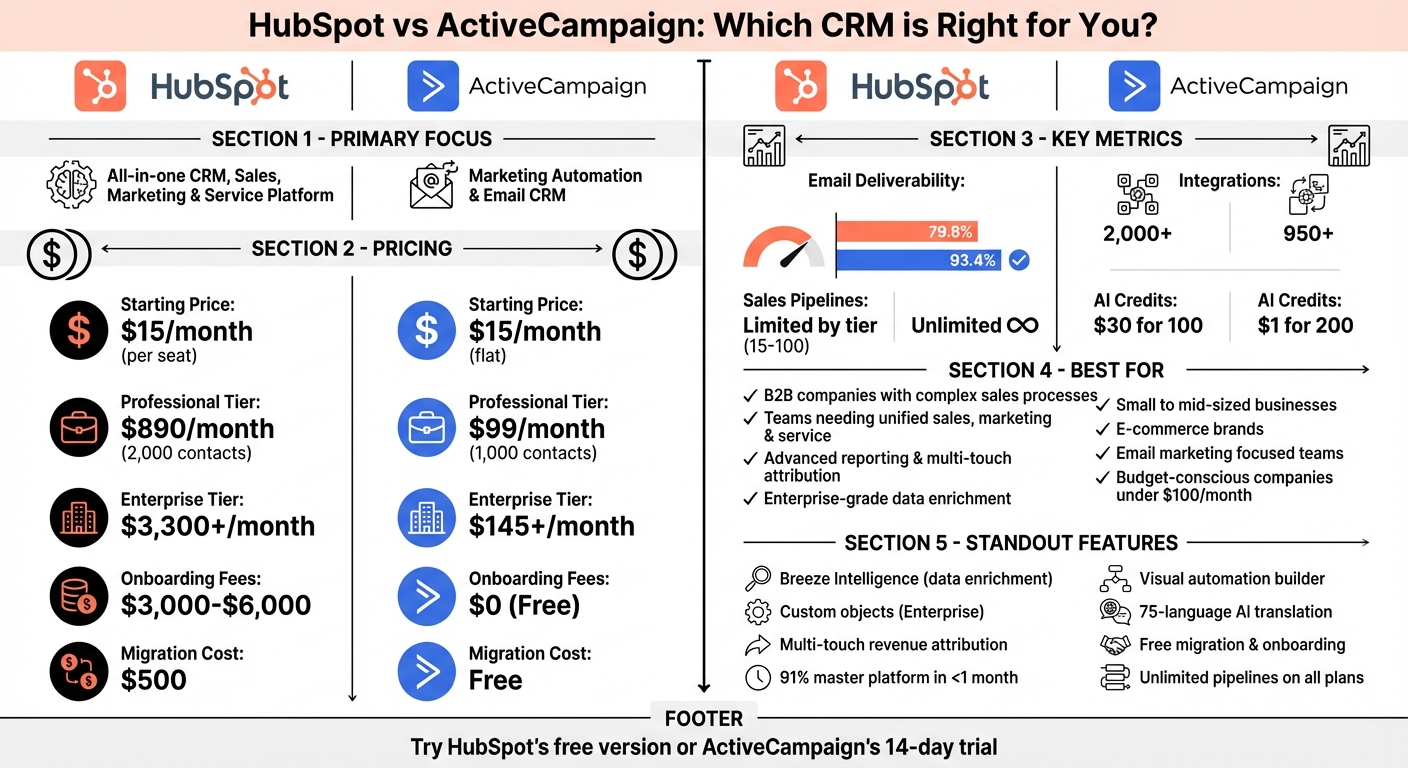
HubSpot vs ActiveCampaign: Complete Feature and Pricing Comparison
ActiveCampaign vs HubSpot in 2025 - Pros, Cons, and Pricing Comparison
Feature Comparison
HubSpot and ActiveCampaign approach CRM and marketing automation from different angles. HubSpot positions itself as an all-in-one platform, using a unified database to provide a complete view of customer interactions. On the other hand, ActiveCampaign emphasizes marketing automation, focusing heavily on behavioral triggers and personalized engagement.
Their automation capabilities also highlight key differences. HubSpot enables users to trigger workflows from a wide variety of events and supports custom-coded actions through its Data Hub - something ActiveCampaign does not offer. Meanwhile, ActiveCampaign simplifies complex workflows with a visual automation builder and a library of pre-made "recipes." As one G2 reviewer remarked, "ActiveCampaign is straightforward to use. It's offering the perfect amount of features without being too bloated (I'm looking at you, HubSpot!)".
In terms of data intelligence, HubSpot’s Breeze Intelligence enriches contact profiles and tracks buyer intent by identifying which companies visit specific website pages. ActiveCampaign instead uses behavioral tags and real-time lead scoring to track actions like cart abandonment or visits to pricing pages. For pipeline management, ActiveCampaign provides unlimited sales pipelines across all plans, while HubSpot caps the number based on subscription level, with up to 100 pipelines available on Enterprise plans.
Let’s dive deeper into the unique features of each platform.
HubSpot Features
This platform shines as a comprehensive ecosystem. It offers over 2,000 pre-built integrations and advanced reporting tools that allow teams to create custom dashboards using data from contacts, deals, or companies. Its custom report builder also supports multi-touch revenue attribution, helping teams understand which interactions drive conversions.
HubSpot’s Breeze AI adds another layer by generating content, assisting customer service agents, and enabling predictive lead scoring. For lead management, the platform consolidates all interactions - whether from social media, email, or other channels - into one universal inbox. Marketing Director Rosellina Castagna from Convierte Más shared her experience:
"HubSpot gives me more customized options than ActiveCampaign for every touch point we have. For example, I can set up workflows that automatically trigger if a certain behavior occurs".
Her company also managed to cut marketing tool subscription costs by 47% after adopting HubSpot.
However, some of the platform’s advanced features, like predictive lead scoring and custom objects, are only available on the Enterprise plan, which start at $150 per month per seat.
ActiveCampaign Features
ActiveCampaign’s strength lies in its marketing automation capabilities. Its visual automation builder allows users to create advanced follow-up sequences triggered by specific actions, all without needing technical skills. Susan Boelman, a user of the platform, praised it by saying:
"ActiveCampaign's automation feature is by far the best and the most intuitive automation builder you can find in the market".
The platform’s Active Intelligence leverages AI to design and optimize campaigns with minimal manual input. For businesses operating in multiple languages, ActiveCampaign offers built-in AI translation for emails in 75 languages. This feature ensures campaigns are automatically sent in the recipient’s preferred language - a functionality HubSpot doesn’t natively provide.
ActiveCampaign integrates with roughly 950 tools and offers features like win probability scoring and AI-optimized calendars, often at lower price points compared to HubSpot. Customization options, such as custom fields and account branding, are available starting at the Plus tier, which costs $59 per month. However, its reporting capabilities are more focused on campaign and automation performance, lacking the in-depth sales analytics that HubSpot provides.
Key Feature Comparison
Here’s a quick side-by-side comparison of the two platforms:
| Feature | HubSpot | ActiveCampaign |
|---|---|---|
| Primary Focus | All-in-one platform (Sales, Marketing, Service) | Marketing automation with sales CRM |
| Integrations | 2,000+ | 950+ |
| Sales Pipelines | Capped by plan (100 for Enterprise) | Unlimited on all tiers |
| Email Deliverability | ~79.8% | ~93.4% |
| Data Enrichment | Breeze Intelligence (Native) | Requires third-party tools |
| Custom Code in Workflows | Yes | No |
| Reporting | Advanced custom builder & multi-touch attribution | Standard campaign and automation reports |
| Custom Objects | Available (Enterprise only) | Available (Enterprise only) |
Both platforms bring unique strengths to the table, catering to different business needs and priorities.
Pricing and Costs
HubSpot and ActiveCampaign use different pricing models that cater to varying business needs. HubSpot employs a hybrid approach, combining per-seat and per-contact pricing, while ActiveCampaign bases its costs on contact volume and feature tiers. Knowing these structures can help you estimate how expenses will grow as your business scales.
HubSpot includes mandatory onboarding fees starting at $1,500 for higher-tier plans. In contrast, ActiveCampaign provides free migration and onboarding for its Pro and Enterprise plans. For comparison, HubSpot’s Marketing Hub Professional starts at approximately $890 per month for 2,000 contacts, whereas ActiveCampaign’s Professional plan begins at just $99 per month for 1,000 contacts.
Additionally, HubSpot charges $30 per month for 100 AI credits (with bulk enrichment costing up to $5,000), while ActiveCampaign offers 200 credits for only $1 per month.
HubSpot Pricing
This platform offers a free tier with basic CRM, email marketing, forms, and landing pages, making it an appealing option for startups experimenting with the platform. However, costs rise significantly as you unlock advanced features.
- Starter Plan: Starts at $15 per month per seat (annual billing), covering 1,000 contacts and 5,000 email sends.
- Professional Plan: Costs approximately $890 per month, includes 3 core seats and 2,000 marketing contacts, and requires a $3,000 onboarding fee. Sales Hub Professional is priced at $90 per month per seat.
- Enterprise Plan: Begins at $3,600 per month, offering 5 core seats and 10,000 marketing contacts. Sales Hub Enterprise costs $150 per month per seat and includes a $3,500 onboarding fee. This tier provides advanced analytics, custom objects, and expanded sales pipeline limits.
ActiveCampaign Pricing
ActiveCampaign’s pricing is simpler and more affordable for businesses starting out.
- Starter Plan: Priced at $15 per month (annual billing), it includes 1 user and basic automation with up to 5 actions per workflow.
- Plus Tier: Costs $49 per month, offering 1 user, unlimited automation actions, and landing pages.
- Professional Plan: At $99 per month, this tier supports 3 users, predictive content, and attribution tracking - features comparable to HubSpot’s Professional level.
- Enterprise Plan: Starts at $145 per month, providing 5 users, custom objects, single sign-on, and a dedicated account team.
While ActiveCampaign’s CRM capabilities require add-ons starting at about $50 per month, HubSpot includes CRM tools across all its tiers.
Pricing Comparison Table
| Feature | HubSpot | ActiveCampaign |
|---|---|---|
| Starting Price | $15/seat/month | $15/month |
| Free Version | Yes (robust features) | No (14-day trial only) |
| Onboarding Fees | $1,500–$7,000 (Pro/Enterprise) | None |
| Professional Tier | ~$890/month (includes 3 core seats and 2,000 contacts) | ~$99/month (1,000 contacts) |
| Enterprise Tier | $3,600+/month (includes 5 core seats) | $145+/month |
| Migration | ~Professional services start at $250 | Free (Pro/Enterprise) |
| Sales Pipelines | Limited by plan (e.g., 15 for Pro) | Unlimited on all tiers |
| AI Credits | $30 for 100 credits | $1 for 200 credits |
| A/B Testing | Higher tiers only | All paid plans |
sbb-itb-8aac02d
Usability and Support
When it comes to day-to-day efficiency, usability and support play a key role alongside feature sets and pricing. Impressively, 91% of HubSpot users report mastering the platform within a month or less. It offers an intuitive interface designed to get users up and running quickly. This CRM also includes an interactive tour for new users, and sales teams can personalize their dashboards by dragging and dropping reports, resizing widgets, and bookmarking specific views like leads or the inbox. Managers benefit from real-time formatting options, transforming data into scatterplots, bar graphs, or pie charts to monitor individual salesperson performance.
ActiveCampaign, on the other hand, provides a widget-based dashboard where users can add sections for tasks, campaigns, and top contacts. The interface offers helpful prompts for common tasks, such as setting up pipelines, and a search bar for quick navigation of contacts, campaigns, or deals. However, some users find the menu structure a bit cumbersome, with multiple sub-menus potentially slowing down access to tools. Despite this, both platforms prioritize creating efficient user experiences.
Support options are another area where these platforms diverge. HubSpot restricts phone support to its Professional and Enterprise tiers, leaving free users reliant on its expansive knowledge base, HubSpot Academy, and community forums. Meanwhile, ActiveCampaign includes email and chat support across all paid plans. Migration services also differ: HubSpot offers professional migration services starting at $250, while ActiveCampaign offers complimentary migration for contacts, templates, and workflows.
For onboarding, HubSpot provides a robust Academy featuring certifications, video training, and an extensive knowledge base. However, Professional and Enterprise users must pay onboarding fees ranging from $1,500 to $7,000. ActiveCampaign takes a different approach, offering free "Study Hall" workshops along with free design services for branded email templates and landing pages (which you can further optimize for lead generation) - onboarding is included at no extra cost.
| Platform | Pros | Cons |
|---|---|---|
| HubSpot | User-friendly interface; 91% master it in under a month; customizable reporting; extensive training resources | No phone support for lower tiers; costly onboarding fees; $500 migration fee |
| ActiveCampaign | Free migration services; widget-based dashboard; email/chat support on all plans | Menu navigation can feel cluttered; steeper learning curve for advanced automation features; no free-forever plan |
Best Use Cases
When to Choose HubSpot
HubSpot is a great fit if you need a centralized platform that combines sales, marketing, and service in one place. If your team struggles to track the full customer journey, HubSpot's unified system addresses this by keeping all data accessible and connected. Marcus Conway, Senior Vice President at Software2, shared his experience:
"HubSpot was the only platform that is simple to implement and operate. It also allowed us to see the entire customer journey from start to finish and gave us a full view of how customers engaged with us at every touchpoint".
For growing B2B companies with complex sales processes, HubSpot's advanced tools can be a game-changer. Its Breeze Intelligence feature enriches contact profiles and identifies which companies visit specific web pages - an essential tool for enterprise sales teams targeting high-value leads. Additionally, custom objects allow you to track unique data, such as subscriptions or shipments, while multi-touch revenue attribution gives managers clarity on which marketing efforts are driving results.
Next, let’s see how ActiveCampaign can meet your business needs.
When to Choose ActiveCampaign
ActiveCampaign is ideal if your focus is on email marketing and automation while keeping costs low. It offers advanced automation tools paired with excellent email deliverability, helping your messages land where they matter most - your customers' inboxes.
Small to mid-sized businesses and e-commerce brands often find ActiveCampaign’s simplicity appealing. Rebecca Hawkes, a Confidence Coach and Content Creator, highlighted its strengths:
"ActiveCampaign is simple to use” and makes it easy to duplicate automations and workflows".
The platform’s visual automation builder simplifies creating complex customer journeys, making it accessible for teams of all sizes. Plus, ActiveCampaign includes free migration services and custom email template design at no additional cost - helping you get started without hidden onboarding fees.
| Choose HubSpot If You Need | Choose ActiveCampaign If You Need |
|---|---|
| All-in-one platform for sales, marketing, and service | Advanced email marketing on a budget |
| Advanced CRM with custom objects | Easy-to-use visual automation tools |
| Unified database across departments | High email deliverability |
| Enterprise-grade reporting and attribution | Streamlined CRM for pipeline management |
| Professional-level features | Costs under $100/month with scalability |
| Tools for data enrichment and buyer intent tracking | Free migration and onboarding services |
Conclusion
Choosing the right CRM boils down to what your business truly needs. HubSpot and ActiveCampaign each bring unique strengths to the table, so the decision depends on your priorities.
HubSpot CRM shines as an all-in-one platform, seamlessly connecting sales, marketing, and service teams through a shared database. This unified approach provides a clear picture of the customer journey. Its lead generation and automation solutions are highly effective, but the cost increases significantly as your business scales - Marketing Hub Professional plan is about $890/month, while the Enterprise plan begins at $3,600/month.
On the other hand, ActiveCampaign focuses on delivering robust email marketing and automation at a much lower price point. With an impressive 93.4% email deliverability rate compared to HubSpot's 79.8%, your emails are more likely to land in inboxes. Plans start at just $15/month, with Professional plans start at $99/month for up to 1,000 contacts. Additionally, ActiveCampaign offers free migration services and skips mandatory onboarding fees.
HubSpot is ideal for B2B companies with intricate sales processes and a need for unified data across departments. Meanwhile, small-to-medium businesses and e-commerce brands may find ActiveCampaign's automation tools more aligned with their needs - and their budgets.
Before committing to either, consider trying ActiveCampaign's 14-day free trial and HubSpot's free version. Testing both platforms will give you a better sense of which one fits your team's workflows and day-to-day operations. That said, if you're planning for long-term growth and want a system that can scale with your business across sales, marketing, and customer management, starting with HubSpot CRM can be a practical first step, with the flexibility to expand as your needs evolve.
FAQs
What are the key differences between HubSpot and ActiveCampaign in pricing and features?
When comparing HubSpot and ActiveCampaign, the main distinctions come down to pricing and the range of features they provide.
ActiveCampaign starts at just $15 per month (when billed annually), making it a more budget-conscious option. It’s particularly well-suited for small to medium-sized businesses, offering powerful tools for email marketing, automation, and CRM. Some standout features include advanced segmentation, unlimited automation actions, and easy integrations with other platforms.
HubSpot takes a different approach as a comprehensive, all-in-one solution. While it does offer a free tier, its paid plans are priced higher, reflecting its broader capabilities. These include advanced lead generation tools, highly customizable workflows, and CRM features designed for enterprise-level needs. HubSpot is a great fit for businesses looking to streamline large-scale operations under one unified system.
Which platform provides better email deliverability: HubSpot or ActiveCampaign?
HubSpot is frequently seen as having an edge over ActiveCampaign when it comes to email deliverability. This advantage stems from its powerful tools designed to generate high-quality leads and fine-tune campaigns, helping emails land in inboxes more consistently.
Both platforms offer solid features for email marketing, but HubSpot stands out with its advanced analytics and automation tools, which play a key role in boosting deliverability rates. While the right choice ultimately depends on your specific goals, HubSpot's emphasis on campaign optimization often gives it a clear advantage in this area.
What onboarding and migration support do HubSpot and ActiveCampaign provide?
Both HubSpot and ActiveCampaign provide services to ease the transition to their platforms, but they approach onboarding and migration a bit differently.
ActiveCampaign offers free, personalized migration support for up to 10 items - this can include contact lists, forms, and templates. They also provide live, one-on-one training sessions to guide users through setting up automations and campaigns. This hands-on approach makes it easier for users to get started with the platform.
HubSpot, however, caters to businesses with more extensive or complex data needs. Their migration services are designed to integrate marketing, sales, and customer service data seamlessly. With professional support, they aim to ensure that the platform scales effectively and aligns with a company’s broader goals. While ActiveCampaign focuses on free migration for initial setup, HubSpot places emphasis on offering strategic, long-term assistance.