Synergi Pipeline is a server-based software designed for pipeline integrity management, offering tools for risk modeling, compliance tracking, and integration with GIS and ERP systems. It supports the full Plan-Do-Check-Act (PDCA) cycle, allowing operators to manage inspections, analyze risks, and address regulatory needs. Its standout feature is a "white box" modeling environment, enabling custom risk models tailored to specific operations. While it provides centralized data management and built-in compliance tools, it requires on-premise infrastructure maintenance, unlike SaaS solutions.
Key Features:
- Risk Modeling: Customizable "white box" environment.
- Compliance: Built-in regulatory tracking.
- Integration: GIS (Esri) and ERP system connectors.
- ILI Tools: In-Line Inspection data integration for anomaly detection.
- HCA Analysis: Identifies High Consequence Areas using spatial data.
Quick Comparison:
| Feature | Synergi Pipeline | NI Integrity APS | Custom PIM Tools |
|---|---|---|---|
| Risk Modeling | Customizable templates | Pre-built industry modules | Fully custom-built |
| Data Integration | Built-in GIS/ERP connectors | Spatial data integration | Custom-coded integrations |
| Maintenance | On-premise infrastructure | Varies by deployment | High internal resource need |
| Deployment Speed | Moderate | Moderate | Slow |
| Compliance Tracking | Built-in | External tracking needed | Custom-built |
For teams balancing regulatory requirements, risk management, and data integration, Synergi Pipeline offers a structured solution, though it requires infrastructure management.
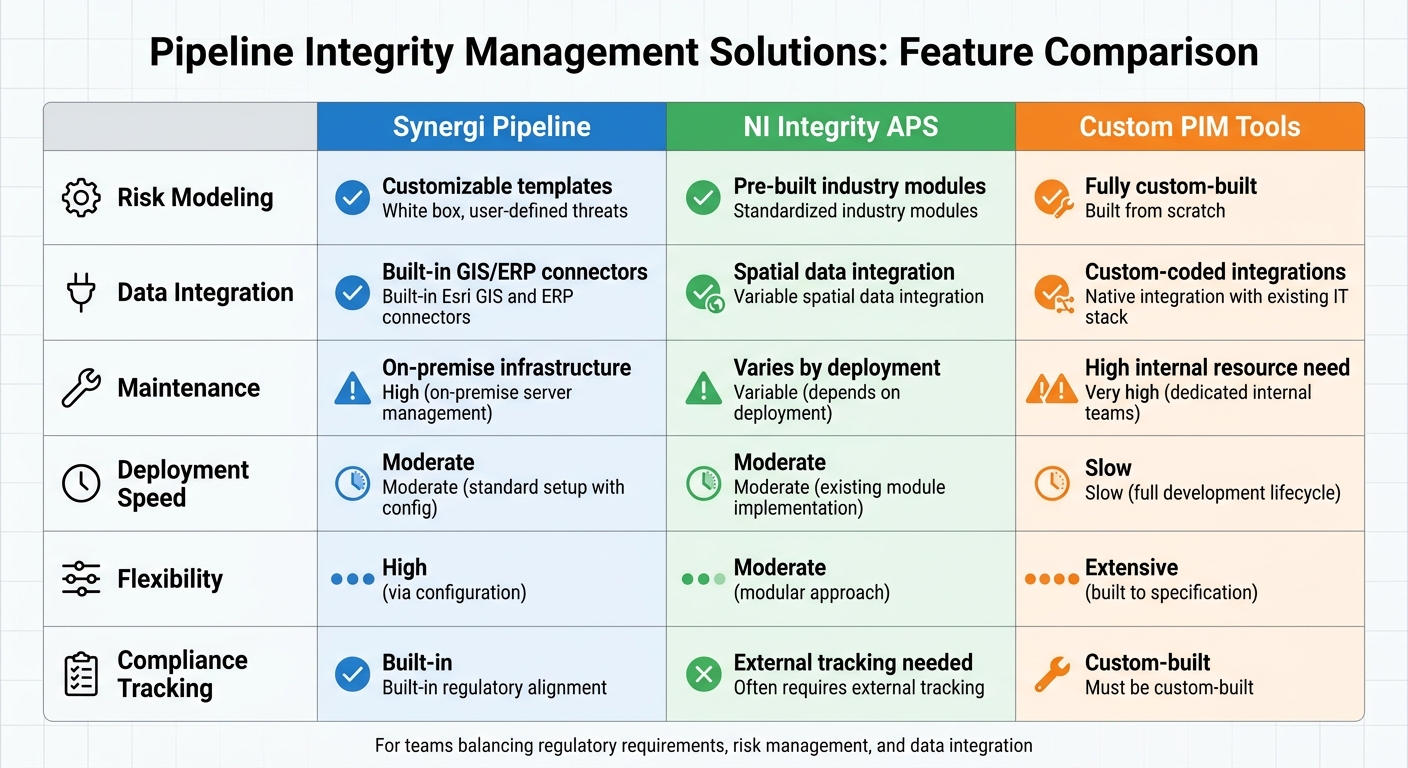
Synergi Pipeline vs NI Integrity APS vs Custom PIM Tools Feature Comparison
1. Synergi Pipeline
On-Premise Maintenance Features
Synergi Pipeline consolidates data for onshore, offshore, and gas distribution pipelines, making large-scale analysis easier and integrating smoothly with GIS (Esri) and ERP systems. This server-based solution gives operators full control over their data infrastructure, supporting the entire integrity management process - from scheduling inspections to ensuring regulatory compliance and gathering field data.
The platform also uses role-based access to secure data, allowing operators to oversee integrity activities while maintaining audit-ready documentation.
Risk Modeling Capabilities
Synergi Pipeline’s centralized framework includes advanced risk modeling tools. Its "white box" modeling environment lets operators define specific threats and create custom risk models tailored to their operational needs. This level of transparency improves both auditability and precision, helping to meet regulatory standards. As DNV explains:
Pipeline operators have increasingly stringent regulatory requirements to comply with, but at the same time ever more opportunities to benefit at all levels from advances in technology.
The system also offers instant risk overviews using interactive visualizations. Additionally, DNV experts, who contribute to international pipeline standards, play a key role in the platform’s development.
ILI Alignment
With its integrated GIS and ERP capabilities, Synergi Pipeline features specialized In-Line Inspection (ILI) tools. These tools ensure inspection data directly informs risk models and maintenance workflows, helping operators identify anomalies and incorporate ILI findings into their integrity management strategies.
Support for HCA Analysis
The platform’s GIS integration enables spatial analysis to identify High Consequence Areas (HCAs) by mapping pipeline routes against population density and environmental factors. The "white box" modeling environment further allows teams to customize HCA risk assessments to meet specific regional regulatory demands.
sbb-itb-8aac02d
2. NI Integrity APS
ILI Alignment
NI Integrity APS uses a spatial alignment engine to transform raw vendor data into accurate GIS coordinates. This process automates the matching of anomalies across multiple inspection runs, making it easier to pinpoint active corrosion and track defect progression over time. These tools provide a strong foundation for conducting effective HCA (High Consequence Area) analysis.
Support for HCA Analysis
NI Integrity APS enhances risk management and ensures compliance with regulations by combining risk documentation, regulatory tracking, and the full plan–do–check–act cycle for both onshore and offshore pipelines. This system aligns with the growing need for precision and integration in pipeline maintenance, offering a solid framework for maintaining safety and integrity in various operational settings.
3. Custom PIM Tools
On-Premise Maintenance Features
Custom-built pipeline integrity management tools are designed to meet the specific needs of a company and typically operate on dedicated servers. These tools handle the planning, execution, and tracking of integrity activities. However, they require significant internal resources to maintain. Unlike standardized platforms, these tools don’t come with preloaded compliance scheduling, meaning updates for regulatory changes must be managed manually. This places the responsibility for updates, bug fixes, and feature enhancements squarely on the company's IT and engineering teams, often leading to higher long-term costs.
Risk Modeling Capabilities
Custom PIM tools shine when it comes to tailored risk modeling. They are built to address unique operational requirements, offering flexibility that standardized systems may not. However, this level of customization comes with a trade-off. Development takes more time, and ongoing maintenance can be resource-intensive. For example, each new threat model or risk factor requires custom coding instead of straightforward configuration. Additionally, companies miss out on the convenience of pre-built templates and quick risk assessments offered by standardized platforms. The choice boils down to prioritizing complete customization versus faster deployment with vendor support.
| Feature | Synergi Pipeline (Standardized) | Custom PIM Tools |
|---|---|---|
| Risk Modeling | White box, configurable templates | Bespoke, built from scratch |
| Compliance | Built-in industry standards/codes | Manually managed by the internal team |
| Integration | Standard GIS/ERP connectors | Custom-coded integrations |
| Updates | Regular vendor-led updates | Internal team-led maintenance |
ILI Alignment
Seamless integration with In-Line Inspection (ILI) data is another key consideration. Effective ILI assessments depend on smooth data integration with GIS systems. While custom tools can handle this, they often require custom API development for every integration point. This adds time and cost to the implementation process, especially when compared to standardized platforms that come with built-in GIS connectors. On top of that, aligning anomalies across multiple inspection runs involves custom coding and rigorous testing to accommodate the unique data structure of each pipeline network. This makes the process more complex and time-consuming.
Antea Pipeline Integrity Management Software
Strengths and Weaknesses
When you compare Synergi Pipeline with other solutions, its standout features and inherent challenges become more apparent.
One of Synergi Pipeline's biggest strengths is its white box modeling environment. This allows companies to define their own threats and build custom risk models with complete transparency. Unlike black box systems, this gives users more control, but it does require a high level of internal expertise to create and maintain these models effectively. Another major advantage is its centralized data management, which consolidates all offshore and onshore pipeline data into a single system, avoiding the inefficiencies of managing data across multiple platforms.
The platform supports the PDCA (Plan-Do-Check-Act) cycle, simplifying the process of integrity management from assessment to mitigation. Its status as an Esri Partner Solution also enables seamless GIS and ERP integration right out of the box. This eliminates the need for costly custom middleware, which is often an issue with custom-built tools. Moreover, Synergi Pipeline includes specialized tools for cathodic protection and built-in features for regulatory compliance tracking. However, these advantages come with certain trade-offs that can limit operational flexibility.
On the downside, Synergi Pipeline operates as an on-premise server platform, meaning your organization is responsible for maintaining the infrastructure, including server hardware, databases, and web hosting. This is a stark contrast to modern SaaS solutions, where the vendor handles these responsibilities. While the platform's standard setup and configuration options allow for faster deployment compared to building a system from scratch, it lacks the complete flexibility that fully custom Pipeline Integrity Management (PIM) tools can offer.
The white box modeling approach, while transparent, places the burden of defining risk models on the user instead of providing pre-configured algorithms. Competing solutions handle this differently - NI Integrity APS, for example, uses standardized, industry-specific risk modules, while custom tools can be tailored to exact specifications but require dedicated development teams for ongoing support.
Here’s a breakdown of the key strengths and weaknesses across Synergi Pipeline, NI Integrity APS, and custom PIM tools:
| Feature | Synergi Pipeline | NI Integrity APS | Custom PIM Tools |
|---|---|---|---|
| Risk Modeling | White box; user-defined threats | Standardized industry modules | Fully customized to specifications |
| Data Integration | Built-in Esri GIS and ERP connectors | Variable spatial data integration | Native integration with existing IT stack |
| Maintenance | High (on-premise server management) | Variable (depends on deployment) | Very high (dedicated internal teams) |
| Deployment Speed | Moderate (standard setup with config) | Moderate (existing module implementation) | Slow (full development lifecycle) |
| Flexibility | High (via configuration) | Moderate (modular approach) | Extensive (built to specification) |
| Compliance Tracking | Built-in regulatory alignment | Often requires external tracking | Must be custom-built |
Conclusion
Looking back at the earlier comparison, Synergi Pipeline combines strong features with efficient on-premise management. One of its standout qualities is its transparent white box modeling, which provides full visibility into its algorithms. This setup allows for flexible configurations without the hassle of lengthy development timelines.
The platform also excels in centralized data management, thanks to its seamless integration with Esri GIS and ERP systems. This creates a single, reliable source for all pipeline data, simplifying the PDCA cycle while cutting out middleware expenses. For organizations already using Esri or ERP technologies, this integration adds a clear advantage.
That said, the on-premise deployment means your team will need to handle server upkeep, database management, and web hosting. This trade-off is worth evaluating. For organizations with strict regulatory requirements, Synergi Pipeline's built-in compliance tracking can save time and effort by removing the need for custom solutions.
For GIS-focused teams managing complex assets and navigating tight compliance needs, Synergi Pipeline offers a practical way to address on-premise maintenance demands while delivering robust tools for regulatory alignment and operational efficiency.
FAQs
What infrastructure is required to run Synergi Pipeline on-premises?
Running Synergi Pipeline on-premises means setting up the right server infrastructure. This includes having a supported database, a compatible server operating system, and the necessary software components installed. For all the specifics, refer to the technical and installation guides provided by DNV.
How much expertise is needed to build and maintain “white box” risk models?
Building and maintaining "white box" risk models demands a high level of expertise. This process involves pinpointing threats unique to a specific company and developing customized risk models within a specialized framework. To achieve accurate and effective results, a deep knowledge of pipeline integrity and risk management is absolutely critical.
How does Synergi Pipeline connect ILI data to GIS-based HCA analysis?
Synergi Pipeline combines ILI (In-Line Inspection) data with GIS-based HCA (High Consequence Area) analysis through specialized tools. These tools streamline ILI assessments and integrate smoothly with GIS systems. This allows users to visualize and manage pipeline integrity and risk data directly within GIS platforms, simplifying analysis and improving decision-making processes.