Why Your Sales Team Is Wasting Time on the Wrong Leads (And How AI Fixes It)
Picture a typical Monday morning.
Your CRM has thirty new leads waiting for follow-up.
A few downloaded an ebook over the weekend. One requested a product demo. Another visited your pricing page four times in the past two days. Several filled out a contact form but haven’t returned to your website since.
Which one should your sales team call first?
For many businesses, that decision still comes down to guesswork.
Sales representatives work through leads one by one, hoping they’re spending time on the right opportunities. Meanwhile, highly interested buyers wait longer than they should, while less qualified prospects receive the same amount of attention.
The problem usually isn’t generating enough leads.
It’s knowing which leads deserve your time.
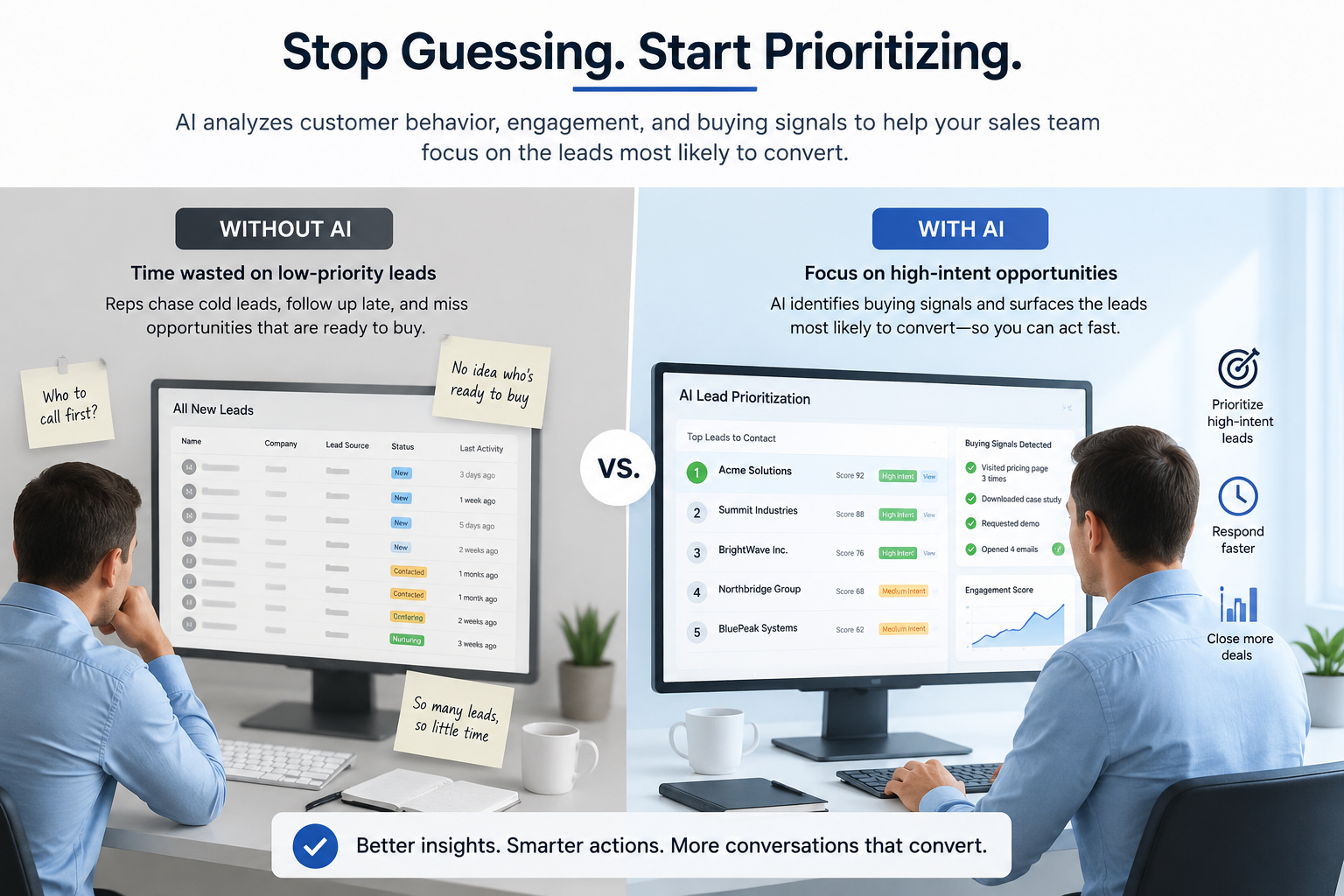
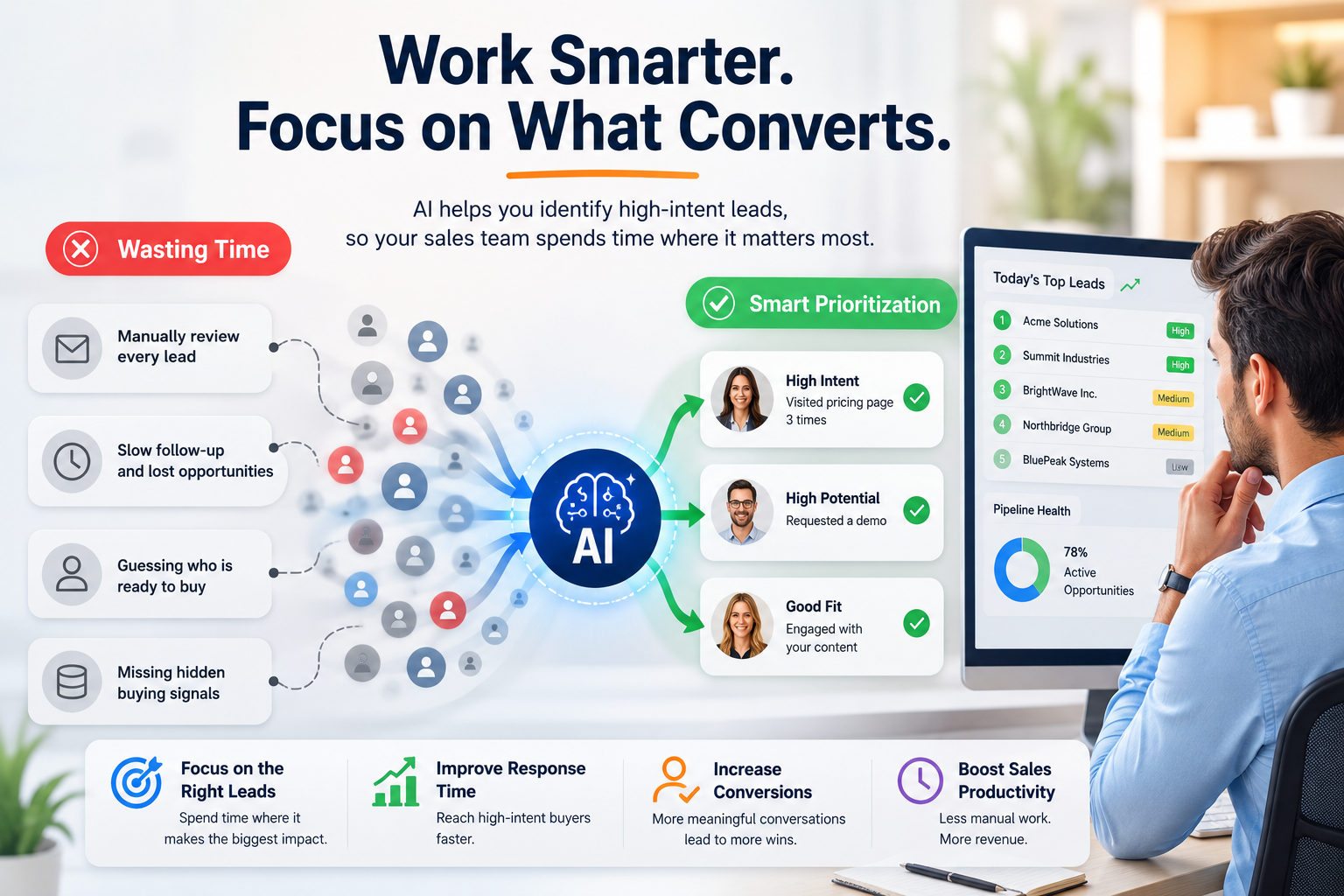
Artificial intelligence is helping businesses solve that problem. Instead of treating every inquiry the same, AI analyzes customer behavior, buying signals, and historical CRM data to identify the prospects most likely to become customers. Rather than replacing salespeople, it helps them spend more time having meaningful conversations and less time chasing opportunities that were never a good fit.
In this guide, you’ll learn why sales teams often waste time on the wrong leads, how that affects business growth, and the practical ways AI helps prioritize opportunities more effectively.
Quick Takeaways
• More leads don’t always produce more sales if representatives focus on the wrong opportunities.
• AI helps identify high-intent buyers before competitors reach them.
• Better lead prioritization improves response times, productivity, and conversion rates.
• Clean CRM data makes AI recommendations significantly more accurate.
• AI supports better decision-making, but successful sales still depend on people.
Why Lead Prioritization Matters More Than Ever
Generating leads has never been easier.
Businesses attract prospects through search engines, social media, webinars, paid advertising, referrals, and email campaigns. The real challenge begins after those leads enter the CRM.
Not every lead is ready to buy.
Some are only researching. Others are comparing vendors. A few may be prepared to make a decision within days.
The difficulty is knowing which is which.
Without a reliable prioritization process, sales representatives often contact leads in the order they arrive instead of the order they’re most likely to convert.
Artificial intelligence helps remove much of that guesswork. Instead of relying on instinct, it evaluates customer behavior, engagement history, CRM data, and buying signals to identify which opportunities deserve immediate attention.
According to Salesforce’s State of Sales, high-performing sales organizations increasingly use AI to improve productivity, forecasting, and customer insights because it allows representatives to spend more time selling and less time managing administrative work.
Businesses with clear pipeline stages often gain even greater value because AI recommendations become much more effective when combined with an organized sales process ().
Sign #1: Every Lead Receives the Same Follow-Up
Why This Happens
It’s easy to assume every new inquiry deserves the same level of attention.
A prospect who downloads a guide receives the same follow-up email as someone who requested a product demonstration. Another person who only visited your homepage receives the same treatment as someone comparing pricing and reading customer success stories.
While this creates a consistent process, it doesn’t create an efficient one.
Your sales team ends up spending valuable time with people who are simply exploring while highly qualified buyers wait for a response.
How AI Helps
AI looks beyond the initial inquiry.
Instead of focusing only on the contact form, it evaluates how prospects interact with your business over time. It considers website visits, email engagement, product pages viewed, previous conversations, and other buying signals to estimate purchase intent.
Rather than asking sales representatives to review every lead manually, AI highlights the people most likely to become customers.
Real-World Example
Imagine your latest marketing campaign generates twenty new leads overnight.
Instead of opening twenty CRM records one by one, your sales team begins the day with five leads already identified as high priority because they recently viewed pricing information, requested product details, and returned to the website multiple times.
Those conversations happen first.
Everyone else continues through automated nurturing until they’re ready.
Key Takeaway
The objective isn’t to contact every lead immediately.
It’s to contact the right leads before your competitors do.
Sign #2: Your Best Leads Wait Too Long
Why This Happens
When sales representatives have dozens of prospects to manage, it’s difficult to know who deserves immediate attention.
As a result, follow-ups often happen in the order tasks appear inside the CRM rather than according to buyer readiness.
Unfortunately, qualified buyers don’t usually wait.
They’re comparing several companies at the same time, and the first business to respond often gains an important advantage.
How AI Helps
AI continuously monitors customer activity instead of looking only at the day someone became a lead.
If a prospect suddenly returns to your pricing page, watches a product demonstration, or begins comparing solutions, AI recognizes those behaviors as stronger buying signals.
When combined with CRM automation, those changes can automatically prioritize follow-up activities so sales representatives respond while interest is still high.
Real-World Example
A prospect downloaded your buying guide three months ago but never replied to your follow-up emails.
This week they return to your website, visit the pricing page twice, and spend several minutes reading customer case studies.
Without AI, that renewed interest could easily go unnoticed.
With AI, the representative receives a notification before starting the workday and reaches out while the prospect is actively researching solutions.
Key Takeaway
Sometimes your next customer isn’t a new lead.
It’s an existing contact who’s finally ready to buy.
Sign #3: Marketing and Sales Disagree About Lead Quality
Why This Happens
Almost every growing business experiences this challenge.
Marketing celebrates a successful campaign because it generated hundreds of new leads.
Sales argues that very few of those leads are actually ready to buy.
Neither team is necessarily wrong.
Marketing measures engagement.
Sales measures buying intent.
Those two things don’t always happen at the same time.
How AI Helps
AI gives both teams a clearer picture of customer readiness.
Instead of evaluating a lead based on one action, such as downloading an ebook, AI considers the entire customer journey.
Has the prospect returned to the website?
Viewed pricing?
Compared products?
Requested additional information?
The more signals AI analyzes, the easier it becomes for both marketing and sales to agree on which leads deserve immediate attention.
Real-World Example
Two prospects download the same industry guide.
One never returns.
The other revisits your website four more times, compares pricing, and books a product demonstration.
Although both entered the CRM the same way, AI recognizes that one prospect has moved much further through the buying journey.
Key Takeaway
AI doesn’t eliminate the need for sales and marketing alignment.
It gives both teams better information for making the same decisions.
Sign #4: Your CRM Is Full of Forgotten Opportunities
Why This Happens
Every CRM accumulates old leads.
Some downloaded resources months ago.
Others attended webinars, requested quotes, or spoke with sales before disappearing.
Over time, these contacts become part of a growing database that few representatives have time to revisit.
The result is a CRM filled with opportunities that may still have potential but rarely receive attention.
How AI Helps
Instead of leaving those records untouched, AI continually monitors customer activity for signs of renewed interest.
It can identify contacts who suddenly begin opening emails again, revisiting product pages, or researching your services after months of inactivity.
These subtle changes often indicate that a prospect has returned to the market.
Real-World Example
A contact who requested pricing last year hasn’t responded in months.
Then, within one week, they open three email campaigns, revisit your pricing page, and download a new buying guide.
Rather than remaining buried in the CRM, AI flags the account for follow-up because customer behavior suggests interest has returned.
Key Takeaway
Some of your best sales opportunities may already exist inside your CRM.
AI helps you recognize them before they’re overlooked again.
Sign #5: Your Sales Team Relies on Guesswork
Why This Happens
Experienced salespeople develop good instincts over time.
They can often tell which prospects seem interested and which ones probably won’t move forward.
The problem is that instincts aren’t always consistent.
One representative may believe a prospect is highly qualified, while another sees little potential. As teams grow, those differences create inconsistent follow-up and make it difficult for managers to predict sales performance.
How AI Helps
AI removes much of the guesswork by comparing current leads with thousands of previous sales opportunities.
Instead of relying solely on opinions, it looks at behaviors that have historically led to successful deals, such as repeat website visits, demo requests, engagement with product pages, and previous interactions.
The result is a more objective way to prioritize opportunities.
Real-World Example
A sales representative is deciding between two prospects.
One responds quickly to emails but hasn’t visited the website in weeks.
The other hasn’t replied yet but has viewed the pricing page several times, compared products, and shared your buying guide internally.
AI identifies the second prospect as showing stronger buying intent, helping the representative focus on the opportunity with greater potential.
Key Takeaway
Good instincts are valuable.
AI strengthens those instincts by supporting them with real customer data.
Sign #6: Sales Representatives Spend More Time Updating the CRM Than Talking to Customers
Why This Happens
CRM software is essential, but keeping it updated can become a full-time job.
After every meeting, sales representatives need to write notes, update deal stages, schedule follow-ups, log activities, and create reminders.
Individually, these tasks only take a few minutes.
Combined across multiple meetings every day, they consume hours every week.
How AI Helps
AI can summarize meetings, recommend CRM updates, identify next steps, and draft follow-up emails automatically.
Instead of starting from scratch after every conversation, representatives simply review the suggestions and make any necessary adjustments.
That means less time on administration and more time speaking with customers.
Real-World Example
A representative finishes five discovery calls before lunch.
Instead of spending the next hour updating CRM records, AI prepares meeting summaries, captures action items, updates opportunity records, and suggests follow-up emails.
The representative reviews everything in minutes before moving on to the next customer.
Key Takeaway
A CRM should support your sales process—not become another task on your to-do list.
Sign #7: Your Sales Forecasts Are Often Inaccurate
Why This Happens
Sales forecasting becomes difficult when every opportunity is treated the same.
Managers often rely on manual updates from representatives, who may be optimistic about deals that have shown little recent activity.
Without reliable information, forecasts become educated guesses rather than meaningful business tools.
How AI Helps
AI continuously evaluates pipeline activity and identifies opportunities that are gaining momentum or beginning to stall.
Instead of relying only on deal stage, it considers customer engagement, recent communication, buying signals, and historical conversion patterns.
Businesses that combine AI insights with structured CRM reporting often make more accurate sales forecasts because decisions are based on customer behavior rather than assumptions.
Real-World Example
Two deals are both marked as “Proposal Sent.”
One customer continues opening emails, scheduling meetings, and reviewing documentation.
The other hasn’t responded for three weeks.
Although both appear identical inside the pipeline, AI recognizes that one opportunity is much healthier than the other.
Key Takeaway
Accurate forecasting begins with understanding buyer behavior, not simply updating deal stages.
Sign #8: You Focus on Finding New Leads While Existing Opportunities Go Cold
Why This Happens
Generating new leads is exciting.
Sales teams naturally focus on fresh opportunities because they feel like progress.
Meanwhile, existing prospects often receive less attention, especially if they haven’t responded recently.
The problem is that buying decisions don’t always happen immediately.
Many customers simply need more time.
How AI Helps
AI keeps monitoring existing prospects, even when sales representatives move on to newer leads.
If someone suddenly returns to your website, downloads another resource, or begins researching products again, AI recognizes that renewed interest and recommends follow-up.
Real-World Example
A prospect requested a quote six months ago before going silent.
Recently, they revisited your website several times and downloaded an updated product guide.
Rather than remaining another inactive CRM record, AI brings the opportunity back to the sales team’s attention.
Key Takeaway
Not every quiet lead is a lost lead.
Sometimes timing is the only thing that changed.
Without AI vs AI-Powered Lead Prioritization
| Traditional Lead Prioritization | AI-Powered Lead Prioritization |
|---|---|
| Representatives review every lead manually. | AI evaluates buying signals automatically. |
| Every inquiry receives similar follow-up. | High-intent prospects are prioritized. |
| Decisions rely heavily on experience. | Decisions are supported by customer data. |
| Valuable opportunities may be overlooked. | AI continuously monitors lead activity. |
| Sales managers manually review pipeline health. | AI highlights opportunities that need immediate attention. |
Common Mistakes Businesses Make
One of the biggest mistakes businesses make is believing AI will automatically improve sales.
It won’t.
AI works best when it’s supported by a clear sales process, accurate CRM data, and representatives who understand their customers.
Another common mistake is trying to automate every interaction.
Customers still expect thoughtful conversations, especially when discussing pricing, contracts, or complex business problems.
Finally, don’t ignore CRM data quality.
Artificial intelligence is only as reliable as the information it receives. Duplicate contacts, outdated records, and incomplete customer profiles reduce the accuracy of AI recommendations.
According to Microsoft, organizations achieve the best results when AI is used to support human decision-making rather than replace it.
Best Practices for Prioritizing Leads With AI
Start by defining what a qualified lead looks like for your business.
Then make sure your CRM captures the information AI needs to evaluate customer intent accurately.
Introduce AI gradually instead of trying to automate every sales activity at once.
Review AI recommendations regularly and encourage representatives to combine those insights with their own experience.
Most importantly, measure results.
Track response times, qualified opportunities, conversion rates, and revenue—not simply the number of leads entering your CRM.
Businesses that improve lead quality almost always outperform businesses that simply increase lead volume.
Frequently Asked Questions
Can AI decide which leads sales representatives should contact?
AI can recommend which prospects deserve immediate attention by analyzing buying signals, CRM activity, website behavior, and historical customer data. Sales representatives still make the final decision.
Does AI replace lead qualification?
No.
AI improves lead qualification by providing additional insights, but experienced salespeople still play an essential role in understanding customer needs and building relationships.
Is AI useful for small businesses?
Yes.
Small businesses often benefit the most because AI helps smaller sales teams accomplish more without increasing headcount.
Do I need a CRM before using AI?
Most AI sales tools perform best when connected to a CRM because they rely on customer data, interaction history, and sales activities to make recommendations.
What’s the biggest benefit of AI lead prioritization?
It helps sales teams spend more time speaking with qualified buyers instead of manually sorting through every inquiry.
Final Thoughts
Most sales teams don’t need to work harder.
They need to work smarter.
Artificial intelligence won’t magically turn every lead into a customer, but it can help your team spend less time guessing, less time on administrative work, and more time building relationships with the people who are genuinely ready to buy.
The businesses seeing the greatest results aren’t replacing salespeople with AI. They’re using AI to remove repetitive tasks, uncover hidden opportunities, and make better decisions throughout the sales process.
As competition for customer attention continues to increase, the teams that succeed won’t necessarily be the ones generating the most leads.
They’ll be the ones identifying the right leads, responding at the right time, and creating the kind of customer experience that technology alone can never replace.

